Blue carbon refers to the organic carbon captured and stored by coastal ecosystems such as mangroves, tidal salt marshes, and seagrass meadows. These habitats sequester excess CO₂ in their biomass and soil for centuries, playing a vital role in mitigating climate change while supporting coastal resilience and biodiversity.
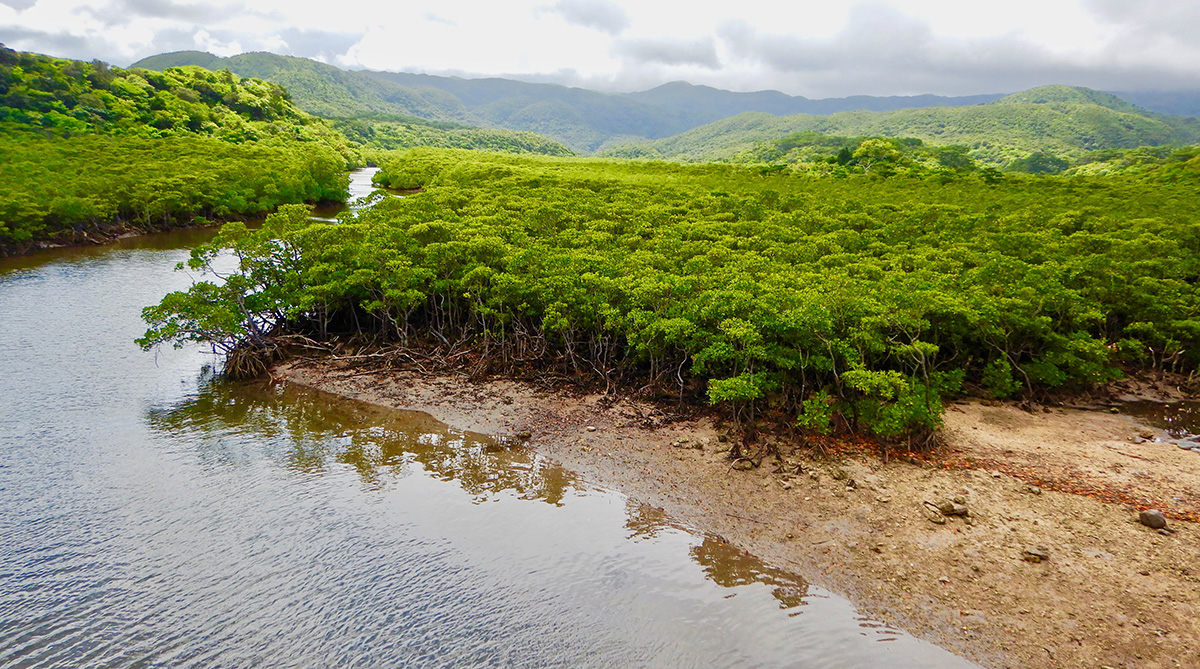
Coastal blue carbon ecosystems–including mangroves, tidal salt marshes, and seagrass meadows–play a critical role in mitigating climate change by sequestering excess CO2 as organic carbon within the soil, the living biomass above ground (leaves, branches, stems), the living biomass below ground (roots), and the non-living biomass (litter and dead wood) for hundreds to thousands of years. These ecosystems are, however, vulnerable to sea-level rise, storm surges, and man-made activities, leading to their rapid degradation. If effectively planned and managed, blue carbon projects could serve as viable funding mechanisms (through carbon credits) for conservation and restoration of coastal ecosystems. To realize this potential, project proponents must be able to assess carbon stocks (the total amount of carbon stored per unit area) in both biomass and sediment pools, monitor their changes over time, and measure carbon fluxes/rates across various ecosystem interfaces (biosphere-geosphere-hydrosphere-atmosphere). These assessments are essential for registering projects in the voluntary carbon market.
Knowledge Gaps
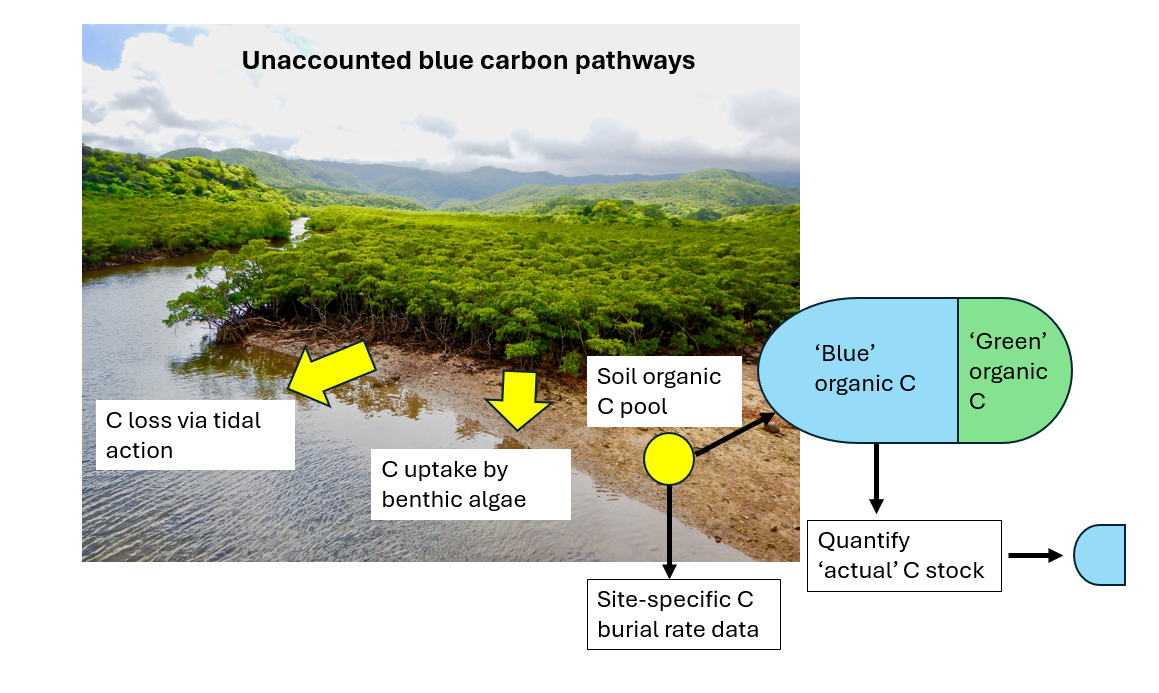
While standard methodologies such as the CIFOR Manual and VM0033 exist for measuring carbon stock, burial rates, and soil emissions across blue carbon habitats (mangroves, seagrass, and salt marshes), limited documentation is available on carbon loss via tidal export (~40% of total ecosystem carbon loss), or carbon gain through fine root production (~39% of net plant productivity), and benthic algal production (~52% of benthic gross primary productivity).
Existing methodologies also offer limited scope for distinguishing ‘green carbon’ from ‘blue carbon’ within sediment organic matter influenced by both upstream (terrestrial) and downstream (marine) sources. This distinction is crucial because conventional blue carbon stock assessments—particularly those in mangrove sediments—often assume mangroves as the sole source of carbon. This introduces significant uncertainty by overlooking riverine (green) carbon contributions. The application of novel techniques like environmental DNA (eDNA) could help address this issue by identifying dominant species contributing to soil organic matter, thereby pinpointing the most significant blue carbon sinks.
Current methodologies also face challenges due to the use of static default factors for carbon estimation, which often fail to account for the spatial heterogeneity of blue carbon habitats. For instance, the Verified Carbon Standard Methodology (VM0033) assumes a sediment carbon accumulation rate of 0.5 tonnes of carbon per hectare per year, which is up to at least three times lower than site-specific values reported globally. To reduce this uncertainty, region-specific mean values derived from updated global carbon inventories—including both stock and burial rates—should be adopted for more accurate and reliable quantification of blue carbon in mangroves.
The impacts of mangrove deforestation and degradation on carbon stocks are relatively intuitive and result in significant losses. However, uncertainties remain regarding how selective harvesting affects carbon stocks, how effective restoration efforts are at restoring these stocks, and the threshold at which harvesting becomes unsustainable.
Finally, existing blue carbon methods are often time-consuming, highly technical, and difficult to navigate. In the context of blue carbon project development, there is a notable lack of readily available, streamlined information. For instance, VM0033 spans over 120 pages, making even basic assessments—such as estimating carbon yield under a baseline scenario—cumbersome during early project development. There is a pressing need for concise, user-friendly resources that simplify this process for practitioners and stakeholders.
Scope of the Manual
A simplified and practical overview of the otherwise complex blue carbon methodologies would be immensely useful for scientific communities to build laboratory capacity and revisit carbon gain/loss pathways with greater clarity.
As a guiding document, such a Manual should provide essential background information on key concepts and offer a step-by-step framework to identify gaps in existing methodologies like the VCS Methodology (VM0033) and CIFOR working papers. Through quantitative assessments of carbon stock and exchange processes in mangroves, seagrass, and salt marshes, the Manual would help users develop plans to address methodological limitations and propose improvements through R&D initiatives or collaborative efforts.
Outreach of the Manual
The Manual’s scope should be global, encompassing carbon assessment across traditional blue carbon habitats, identifying gaps in existing standards, and providing clear and practical recommendations for improvement.
Designed for a diverse group of stakeholders—including scientists, natural resource managers, community organizations, and government agencies—it should offer standardized techniques for measuring carbon stocks in mangrove and seagrass ecosystems. Additionally, the Manual would serve as a valuable resource for project developers and policymakers, supporting the design and implementation of credible carbon projects through conservation and restoration, in line with regulatory frameworks and voluntary carbon market requirements.