Headquarters
The Energy and Resources Institute (TERI)
Darbari Seth Block, Core 6C,
India Habitat Centre, Lodhi Road,
New Delhi - 110 003, India
The Energy and Resources Institute (TERI), in partnership with BSES Yamuna Power Ltd. (BYPL), envisioned EN Powered Schools with an overall objective to make school students understand the grim situation of the energy sector and establish a coexistence between the demand and supply curves. The programme adopted a curriculum-based approach through age-appropriate content. A children’s workbook and other resource materials were developed and disseminated to pave the path for energy-efficient and sustainable school campuses. In addition, students were nurtured through capacity building initiatives such as storytelling sessions, contests, and activities, which transcended sustainable lifestyle both at schools and at home.
Phase II targeted teachers as the pillars of the programme, introducing experiential learning platforms like school action projects, quiz contests, and exposure trips. Development of teachers’ content, along with reprinting the students’ resource book and other IEC materials, was disseminated to spread knowledge in the environmental and energy sector.
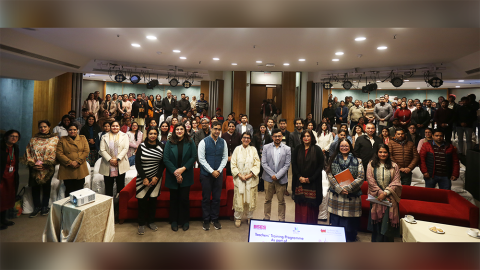
A two-day teachers’ training programme on Energy Conservation and Efficiency was organised from 21-22 January 2026 at The Theatre, India Habitat Centre, Lodhi Road, New Delhi. The initiative focused on building a practical understanding of energy conservation and efficiency among teachers and students. A total of 124 teachers from 70 MCD schools participated in the training from Shahdara South, Shahdara North, and Karol Bagh. The programme aimed to strengthen their understanding of energy-related concepts and ways of incorporating such learning into pedagogy for school children.
The book titled, Rooms, Roads, and Renewables: Case Studies for the Classroom, consists of contextual and locally relevant cases. A book for teachers was developed that incorporates case studies that assist teachers and students in understanding energy issues through solving the cases.
The team of TERI visited each school from December 2025 to February 2026 and conducted quiz workshops on energy conservation and efficiency to raise awareness and provide knowledge to the students. The quiz was conducted in Hindi, as it is easier for the students to read and understand. It was designed for students of Classes 3 to 5. Additionally, the students were divided into teams, which helped promote teamwork and collaborative learning.
One of the objectives of the programme was the adoption of non-formal pedagogy for complementing awareness efforts, and to complement this, TERI organised a study tour to the National Science Centre, New Delhi, for students from Municipal Corporation of Delhi schools. The tour was organised across three days between 18 and 20 February 2026.
The main objective of implementing school action projects was to promote school leadership in the field of energy and intensify knowledge and action for energy and the environment among students. In order to achieve the twin objectives, coordinating teachers with the help of other peers and students have formed the School Energy Club to undertake initiatives independently and in consultation with TERI. The School Action Projects were implemented for a period of 3 months, and each school was disbursed a seed fund of Rs 10,000 to carry out the activities.