
Headquarters
The Energy and Resources Institute (TERI)
Darbari Seth Block, Core 6C,
India Habitat Centre, Lodhi Road,
New Delhi - 110 003, India
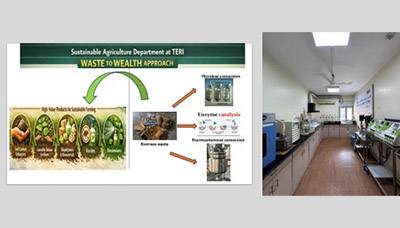
TERI is driving a paradigm shift toward a circular bioeconomy through cutting-edge technologies and interdisciplinary innovation. Over the past decade, TERI has demonstrated scalable, low-carbon, and resource-efficient solutions that enhance soil health, enable carbon sequestration, reduce dependence on synthetic inputs, and strengthen climate-resilient agricultural systems. These efforts reposition agricultural waste from a liability to a strategic resource for sustainable growth and circularity under the project “Precision Biomass Intelligence” (Project Code: 2023AB21).
This initiative has enabled a Gold-standard, Globally Benchmarked Biomass Characterization Aligned with NREL (USA) and leading European standards, enabling next-generation biorefineries through comprehensive feedstock (ligocellulosic biomass, food waste, organic waste, fatty acid, ester, lipids etc.) composition analysis, quality assessment, and process optimization to produce ethanol, biogas & bioproducts. It further facilitates the production of Green Platform Chemicals, Bioproducts and Biomaterials as a sustainable alternative to fossil-based value chains.
With this flagship multi-institutional program implemented in collaboration with IOCL and the ICAR-IARI, we demonstrated scalable pathways for valorizing lignin-rich digestate from biorefineries into soil amendment and nutrient solutions. These innovations enable precision nutrient delivery, reduce environmental losses, and enhance input-use efficiency—thereby significantly improving soil fertility, boosting microbial activity, and advancing circular, climate-smart agriculture.
To address water scarcity and increasing climate variability, TERI has developed bio-based superabsorbent hydrogels and polymers to strengthen agricultural resilience under water stress for improved soil moisture retention and drought mitigation, enhanced seed germination and crop productivity, controlled release of water and nutrients. These solutions directly address critical challenges related to water scarcity and climate change impacts.
Funding Support: Department of Biotechnology (DBT), Government of India; Department of Science and Technology (DST), Government of India; Ministry of Petroleum and Natural Gas (MoPNG), Government of India; Deakin University, Australia; Shell India
Awards, Fellowships & Global Recognition: Alexander von Humboldt Foundation (AvH), Germany, Global Biofuels Alliance (GBA) Championship, Fulbright Award, USA, Rex Williamson Prize (2022), Deakin University, Australia.