Headquarters
The Energy and Resources Institute (TERI)
Darbari Seth Block, Core 6C,
India Habitat Centre, Lodhi Road,
New Delhi - 110 003, India
Guyana Water Incorporated (GWI) is a state-owned utility company fully owned by the Government of Guyana. GWI has faced persistent financial challenges. A major contributor to its high operating costs is energy consumption. The company’s annual electricity usage stands at 53.9 million kWh, with electricity accounting for over 40% of total operating expenses. In 2025 alone, GWI spent more than US$15.4 million on electricity, representing over 4% of the total electricity generated by the national utility.
GWI facilities including bulk water production, water treatment plants, and downstream water distribution systems are highly energy-intensive operations. Currently, GWI operates 140 groundwater well stations across the coastal plain. Of these, 66 wells are connected to 35 water treatment plants (WTPs), while the remaining wells supply water directly to consumers. Assessments indicate that more than 56% of total energy consumption occurs at the WTPs. Studies further revealed that integrating solar photovoltaic (PV) systems under the electrical utility’s net metering scheme represents a viable investment opportunity. Solar PV generation could offset approximately 35% of the current energy demand of individual WTPs.
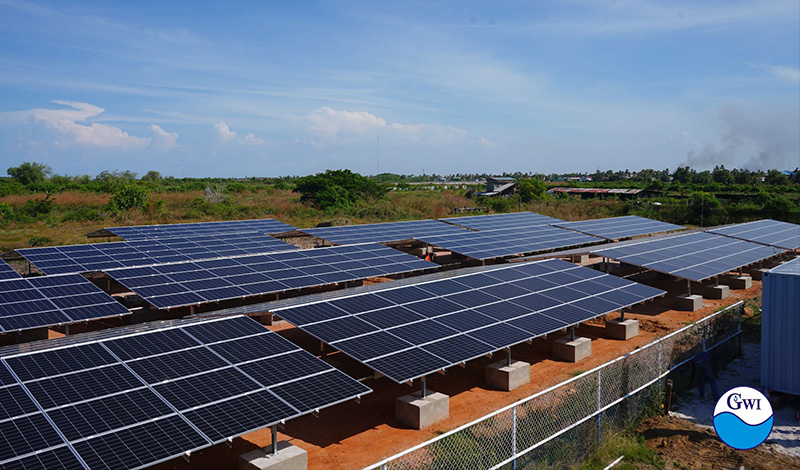
By the end of 2024, the first renewable energy initiative was commissioned with the inauguration of a 300 kW grid-tied solar photovoltaic (PV) system at the Port Mourant Water Treatment Plant in Region 6. This project marked a significant step toward integrating sustainable energy solutions into public utility operations, improving efficiency and reliability while contributing to climate change mitigation efforts. This initiative was designed and supervised during implementation by The Energy and Resources Institute (TERI) in collaboration with the Guyana Energy Agency.
The Mainstreaming Low-Emission Energy Technologies to Build Guyana’s Green Economy (MLEET) initiative, developed by The Energy and Resources Institute (TERI), promotes the integration of renewable energy solutions within water treatment plants and is being implemented with financial support from the United Nations Development Programme (UNDP). The combined operating load of the eight targeted water treatment plants (WTPs) represents approximately 22% of the total pumping capacity of Guyana Water Incorporated (GWI) facilities. Collectively, these WTPs consume about 4.97 million kWh of electricity annually, accounting for more than 14% of the utility’s total energy consumption.
The project includes the installation of eight new grid-tied solar photovoltaic (PV) systems at various locations across the country, with individual capacities ranging from 100 kWp to 200 kWp and a total installed capacity of 1,050 kWp. Over the estimated 25-year operational lifespan of the solar PV systems, the initiative is projected to reduce greenhouse gas emissions by approximately 25,871 tonnes of CO₂ equivalent.
The Mark Phillips described the project as a clear example of ambition translated into action and a strong outcome of collaboration. He noted that the integration of the solar energy system significantly enhances the plant’s reliability and operational efficiency while reducing dependence on conventional energy sources.