
Headquarters
The Energy and Resources Institute (TERI)
Darbari Seth Block, Core 6C,
India Habitat Centre, Lodhi Road,
New Delhi - 110 003, India
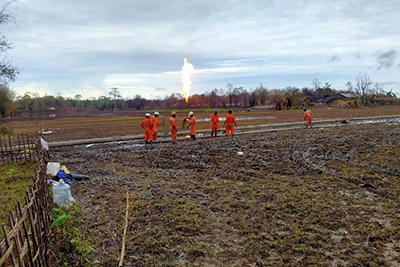
Following the Baghjan well incident, Oil India Limited awarded a bioremediation mandate to restore oil-contaminated land and water bodies at Baghjan village, Tinsukia, Assam. The program applies an eco-friendly, microbe-based (bioremediation) approach developed by Oil India's R&D, with microbial cultures produced at scale by TERI's Gurugram campus and independent verification carried out through a third-party laboratory in Delhi. The contaminated area was mapped into four zones (1–4) to enable systematic treatment and monitoring.
The project demonstrates a scalable, low-impact remediation model that pairs Oil India's indigenous microbial technology with TERI's production and laboratory capability to restore a sensitive ecosystem — converting a contaminated incident site back toward productive, vegetated land.
Apart from the land restoration project at Baghjan village through bioremediation, TERI has successfully implemented several other crude oil-contaminated land remediation work under another bioremediation project for Oil India Limited (OIL) across Assam and Arunachal Pradesh. This project includes sites such as Shalimari (OCS-1 & OCS-2), Kumchai inside EPS and Plinth-15 (Arunachal Pradesh), NHK-486 Well No. 113, Duliajan, and several other operational locations managed by OIL.
The bioremediation work commenced on 18 October 2021, and TERI successfully completed both in-situ and ex-situ bioremediation services on 22 January 2025. The project involved the remediation of more than 42,653 m³ of crude oil-contaminated soil across multiple sites. The remediation activities were executed in four phases, each covering different volumes of contaminated soil as provided by OIL.
The project targeted a Total Petroleum Hydrocarbon (TPH) concentration of less than 5,000 mg/kg within a remediation period of 4–6 months, demonstrating the effectiveness, scalability, and industrial applicability of TERI's bioremediation technology for restoring hydrocarbon-contaminated land under diverse field conditions.