
Headquarters
The Energy and Resources Institute (TERI)
Darbari Seth Block, Core 6C,
India Habitat Centre, Lodhi Road,
New Delhi - 110 003, India
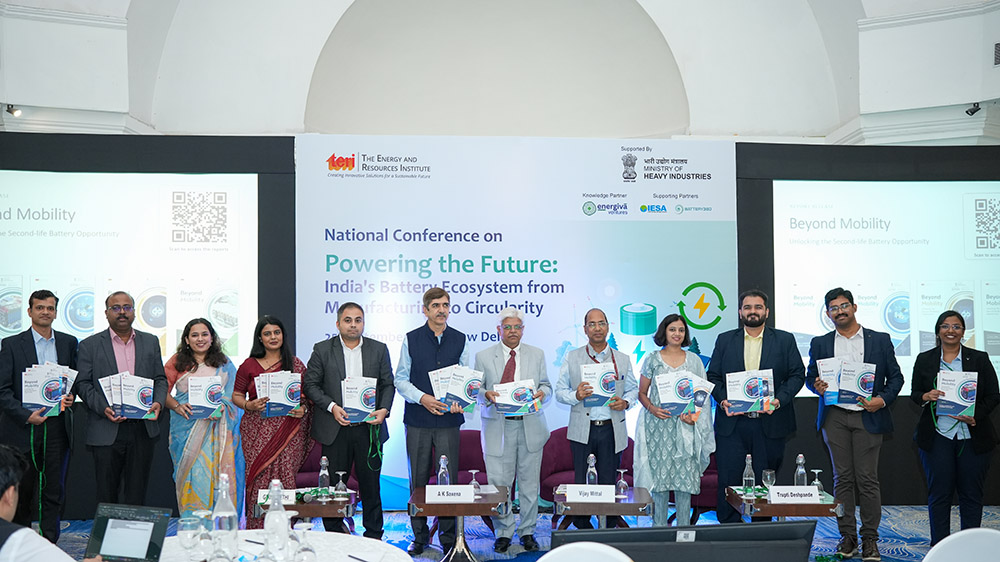
India's battery ecosystem is at a formative stage of development, from the scale-up of domestic Advanced Chemistry Cell (ACC) manufacturing, the rapid growth of electric mobility, to the emerging challenge of managing batteries at end-of-life. The country stands at the intersection of two of the most consequential energy transitions of our time: the electrification of its vehicle fleet and the large-scale integration of renewable energy into its power grid. Both transitions are generating unprecedented demand for battery storage and together they create the strategic conditions for a third transition: the systematic reuse of retired electric vehicle (EV) batteries as low-cost, domestically sourced energy storage assets.
The scale of this opportunity will grow alongside the expansion of electric mobility, with India projected to become one of the world’s largest EV markets by 2030; growing at approximately 49 per cent annually between 2021 and 2030. As India's electric mobility transition matures, it will generate a significant volume of End-of-Life (EoL) EV batteries over the coming decade. While these batteries may no longer be suitable for automotive use, they can retain substantial residual capacity for stationary and other second-life applications. Building a resilient, self-reliant and circular battery ecosystem therefore requires coordinated attention across the full value chain, from manufacturing to deployment, and eventual reuse, repurposing and recycling.
In this context, TERI undertook a study titled "Mainstreaming and Scale-up of the Use of Repurposed EV Battery Solutions for Circularity within the EV Supply Chain", with technical guidance and strategic support from Energiva Ventures. The study aimed to develop strategic, policy, regulatory, technical, and market frameworks to enable the mainstreaming and scale-up of repurposed EV battery solutions in India. The study incorporated stakeholder perspectives from EV OEMs, battery manufacturers, recyclers, testing and certification laboratories, regulators, policymakers, standards bodies, and BESS developers; through stakeholder consultations and two regional workshops held in Bengaluru and New Delhi.
Findings have been consolidated into a knowledge series titled “Beyond Mobility: Unlocking the Second-Life Battery Opportunity.”
India is well positioned to prepare for the next phase of battery circularity. While the number of EV batteries reaching retirement remains modest today, demand for energy storage is large and growing, the dominant battery chemistry is well suited to potential stationary applications, and standards development is already under way. The priority now is to complete the enabling architecture before the scale of retired batteries increases. Responsibility for implementing this proposed action plan spans across different national ministries, regulators, state nodal agencies and distribution utilities, requiring coordinated action across institutions. If implemented within this decade, the agenda set out in this report would convert retired EV batteries from an emerging waste management challenge into a domestic, low-cost and traceable component of India’s energy storage and circular economy systems.