
Headquarters
The Energy and Resources Institute (TERI)
Darbari Seth Block, Core 6C,
India Habitat Centre, Lodhi Road,
New Delhi - 110 003, India
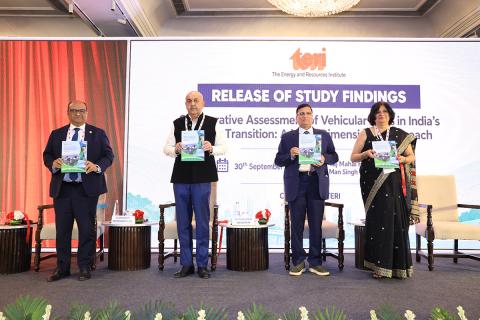
New Delhi, 30 September 2026: The Energy and Resources Institute (TERI) today released the findings of a comprehensive study, “Comparative Assessment of Vehicular Fuels in India’s Energy Transition: A Multi-Dimensional Approach.” The report was formally unveiled at an event held at the Taj Mahal, Man Singh Road, New Delhi, bringing together senior representatives from Ministries (MoP&NG, MoRTH), NITI Aayog, PNGRB, Energy Providers, Infrastructure Developers, automotive OEMs, fleet operators, environmental institutions and academia.
The study contributes to India’s commitment to achieving net-zero carbon emissions by 2070, announced by Hon’ble Prime Minister Shri Narendra Modi at the COP26 climate summit in Glasgow under the five-part “Panchamrita” climate action plan. The study provides a comprehensive, multi-dimensional assessment of alternative vehicular fuel technologies in India, examining their relative performance and suitability across different vehicle segments, operating conditions and regional contexts. It assesses petrol, diesel, CNG, electricity and LNG across six major vehicle segments—two-wheelers, three-wheelers, private four-wheelers, commercial four-wheelers, light commercial vehicles and heavy-duty vehicles—through a structured multi-criteria assessment framework integrating technical, environmental, economic, social and geopolitical considerations. The framework provides a structured basis for comparative assessment of fuel and technology options and can be adapted to assess evolving technologies, operating conditions and market contexts over time.
The study advocates that a ‘one-size-fits-all’ approach to fuel policy is not optimal for India’s diverse mobility needs. Its central finding calls for India to adopt a segmented transport transition strategy, recognizing that different fuels should co-exist and are best suited to different vehicle categories across regions. The study finds that no single fuel performs best across all technical, environmental, economic, social and geopolitical dimensions. Instead, different fuels and technologies have distinct comparative advantages and limitations across vehicle segments and operating conditions, calling for a phased, fleet-specific and region-sensitive approach. The multi-dimensional assessment framework developed through the study provides a structured basis for systematically evaluating these trade-offs and supporting evidence-based decision-making as technologies, infrastructure and market conditions evolve.
Economic considerations emerge as the strongest overall determinant of technology suitability, while infrastructure readiness, life-cycle environmental performance, vehicle characteristics, affordability and energy-security considerations also influence technology choice. The study highlights strong potential for electric mobility in smaller and urban vehicle segments, continued relevance of CNG across several passenger and commercial applications, and a role for LNG in suitable long-haul freight applications.
The programme began with a Welcome Address by Dr Vibha Dhawan, Director General, TERI, followed by an Introductory Address by Sh. Anjani Kumar Tiwari, Member (Commercial), PNGRB, that focused on regulatory roadmaps for multi-fuel infrastructure and differentiated fuel strategies.
Dr Vibha Dhawan, Director General, TERI, remarked, “There is no single silver bullet, a ‘one size fits all’ strategy for India’s mobility transition. Our needs are diverse — from two-wheelers to heavy-duty trucks, from urban mobility to long-haul freight. What works for one segment may not work for another. That is precisely why a multi-fuel strategy is not just an option, but a necessity for India. Each fuel and technology performs best under different conditions. The objective was not to pick winners and losers, but to provide an objective, science-based foundation to informed choices — to understand where which fuel makes most sense, in what time horizon, and for which application.”
Sh. Anjani Kumar Tiwari, Member (Commercial), PNGRB, highlighted, “PNGRB should have had a study on the comparative multi-fuel analysis. We go on creating infrastructure for LNG, natural gas, electricity but economic consideration is very important for consumers, and from a policy perspective, there should be a level-playing field for all players and fuels in terms of subsidies, incentives, i.e., which fuel is best under what operating conditions and what mode. Natural gas is the most preferred fuel that is found in the study, with each fuel infrastructure complementing the other.”
The chief guests formally launched the report, after which Dr Ritu Mathur, Director, Energy Assessment & Modelling, TERI, presented the study’s key findings across fuel segments, covering emissions, economics, logistics, supply chain, and total cost of ownership. Dr Mathur remarked, “There is no single fuel best suited across all fleet types. Each fuel has a role to play across different fleet types and at different phases in the transition journey.”
The event also featured a Special Address by Shri Tarun Kapoor, Advisor to the PMO, and reflections on the study by Shri Subhankar Sen, Director (Marketing), BPCL, followed by the vote of thanks delivered by Shri Mohit Bhatia, Director (Commercial), IGL.
Shri Tarun Kapoor, Advisor to the PMO, Prime Minister’s Office, noted, “Pollution is such an important subject, but still, we don’t have authentic data. The TERI-PNGRB study can support data-driven mobility policy. India needs a multi-fuel approach, not a single-fuel solution. Natural gas remains an important transition fuel. Policymaking should rely on better data for effective pollution control decisions and should consider multiple dimensions such as emissions, affordability, availability, and energy security.”
Shri Subhankar Sen, Director (Marketing), BPCL, averred, “This significant report is coming at a juncture where we must build a transport transition trajectory for the future decades. In electricity, India has made remarkable progress within a short span, with BPCL expanding EV charging. But there has been sustained investment in CNG infrastructure. With PNG drive 3.0, India is finally moving towards a gas-based economy. This report brings great resonance in the low-carbon transition of India’s transport sector; not one fuel replacing everything, but a coexistence of various fuels.”
Shri Mohit Bhatia, Director (Commercial), IGL, shared, “TERI is bringing forward a comprehensive study that looks beyond tailpipe emissions. A multi-fuel approach based on different parameters can bring forward a long-term transport transition.”
This was followed by a panel discussion, “Navigating India’s Multi-Fuel Future: Policy, Technology, and Market Readiness,” moderated by Shri Manas Majumdar, Partner, PwC, with panelists Shri Kumar Shanker, Managing Director, IGL; Shri Subhash Kumar, Director General, ACE; Shri Ashish Chutani, Vice President (Government & Policy Affairs), Maruti; Shri Maqsood Shaikh, CEO, Ultra Gas; Shri Ashu Singhal, CEO, GAIL Gas Limited and Shri IV Rao, Distinguished Fellow, TERI; discussing the practical pathway towards cleaner, affordable, and reliable mobility for consumers. The session concluded with the insightful remarks by Shri Maneesh David Singh, Director (Consumer Affairs), PNGRB, who stressed on the importance of natural gas as part of the fuel basket in the transport planning and policymaking for the future decades, which is followed by felicitation of dignitaries and academicians who contributed to the study, followed by a media interaction jointly conducted by TERI and PNGRB.