Headquarters
The Energy and Resources Institute (TERI)
Darbari Seth Block, Core 6C,
India Habitat Centre, Lodhi Road,
New Delhi - 110 003, India
TERI-led technical session brings together global and Indian experts on PV technology, structural design and farm-compatible models, building on the Union Minister’s reference to TERI’s national potential assessment
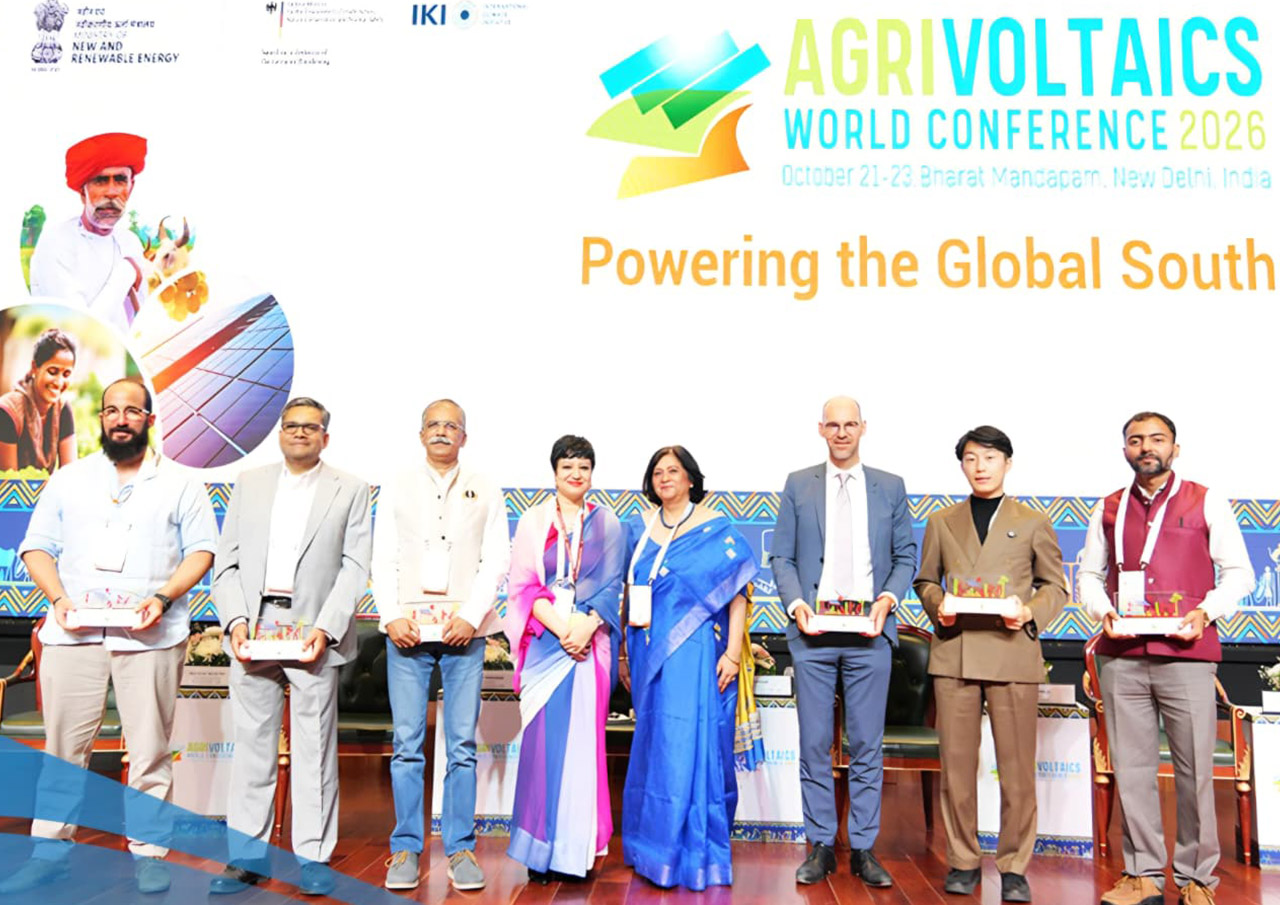
New Delhi, 23 October 2026: The Energy and Resources Institute (TERI) led the technical session “Technology and Design Choices for Indian Conditions” on the concluding day of the 7th Agrivoltaics World Conference, held in New Delhi from 21 to 23 October 2026. The conference was hosted by the Ministry of New and Renewable Energy (MNRE), Government of India, with support from the Indo-German Cooperation on Agrivoltaics project. It is the first time the conference has been held in the Global South.
The session also saw the release of TERI’s latest report titled, Advancing Agrivoltaics in India: Evidence based Best Practices, and Policy Recommendations for the Energy-Food-Water Nexus. It examined which PV technologies, mounting structures and system layouts best suit India’s diverse agro-climatic conditions, crop systems and small landholdings, drawing on lessons from Europe, Japan, and other markets.
The conference was inaugurated on 21 October by Union Minister of Agriculture and Farmers Welfare Shri Shivraj Singh Chouhan and Union Minister for New and Renewable Energy Shri Pralhad Joshi. In his address, Shri Joshi cited a TERI study on India’s agrivoltaic potential, as recorded in the PIB release of the same day.
According to the study, about 47.5 million hectares, or roughly 30 per cent of India’s 160 million hectares of cropland, are technically suitable for agrivoltaics. One deployment scenario covering 16 million hectares estimated annual electricity generation of 12,775 TWh. That is comparable to or higher than India’s projected electricity demand of 5,250–10,020 TWh by 2050. Shri Joshi noted that these are technical estimates and that actual deployment will depend on local conditions and feasibility. He also said that Maharashtra, Rajasthan, Andhra Pradesh, Madhya Pradesh, Karnataka and Uttar Pradesh together account for nearly 50 per cent of the estimated potential.
The session opened with two technical presentations.
Dr James Macdonald, Consultant, ENGIE Research & Innovation, Spain, speaking on “Next-Generation Solar Technologies for Agrivoltaics,” outlined five essential considerations for successful agrivoltaic deployment: “The five Cs of agrivoltaic success are Crops, Climate, Configuration, Compatibility, and Collaboration.”
Dr Bharat Kakade, President and Managing Trustee, BAIF, India, highlighted the potential of integrated agrivoltaic systems to advance agricultural productivity and sustainability. He noted, “Integrating electrification into farm operations can contribute to a 10% reduction in emissions associated with farming. The focus must be on creating an integrated farming system that is self-sufficient and can meet its energy and resource needs through what is generated on the farm itself.”
Mr Nitin Khade, Joint Secretary, Department of Land Resources, Government of India, delivered the keynote address, highlighting the transformative potential of watershed development. He observed, “Following watershed development, farmers have been able to cultivate more than one crop, with incomes increasing by 60–70% and groundwater levels rising by up to three metres. The ultimate objective is to bring prosperity to rural communities.”
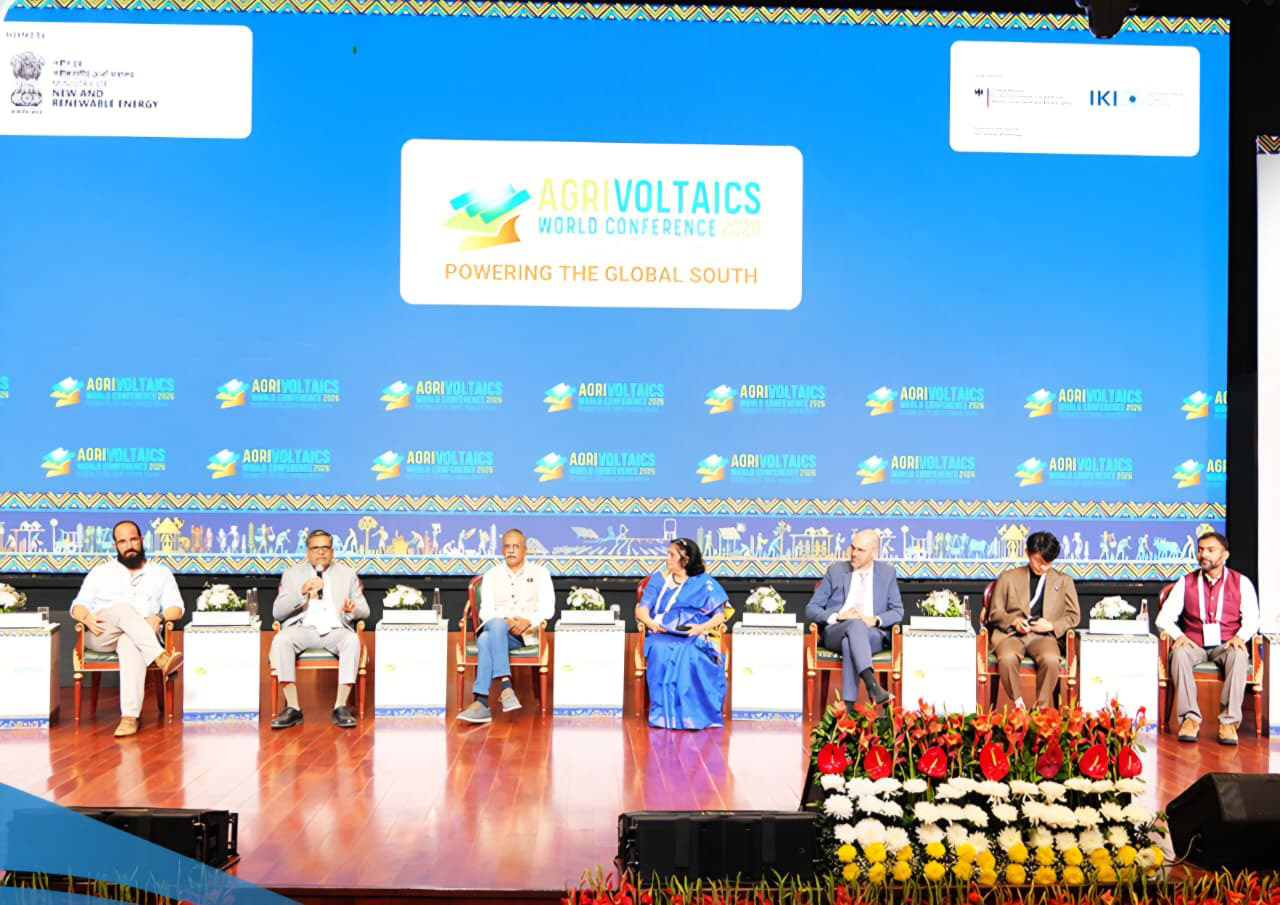
The keynote address was followed by a panel discussion on, “Innovations in PV Technology and Structural Design for Scaling Agrivoltaics.” The session was chaired and moderated by Dr Vibha Dhawan, Director General, TERI. Emphasising the link between the two sectors, Dr Dhawan remarked, “Agriculture and energy must go hand in hand. For India to achieve its development aspirations, it is essential to become self-sufficient in energy.”
Mr Aviad Perry highlighted the importance of crop selection in agrivoltaic systems, noting, “Yield reductions have been observed in certain crops grown under agrivoltaic systems, including reductions of around 40% for onions and 25% for corn. Identifying crop varieties that are best suited to these systems is therefore essential.”
On module technology and manufacturing, Dr Mahesh Murthy, CTO, WAAREE, India, stressed the need to accelerate adoption, stating, “It is time to scale up agrivoltaics in India. Establishing appropriate standards will be essential to ensure effective implementation and optimise the utilisation of these systems.”
Addressing structural design and mounting costs, Mr Prasad Bhagare, Founder and CEO, Ground Screw Company, India, highlighted the advantages of ground-screw foundations. He noted, “Concrete foundations can alter soil pH, while concrete piling can pose challenges because of the difficulty of removal. Ground-screw foundations offer a potential alternative, providing strong anchoring while allowing for easier removal.”
Drawing on European experience and policy lessons, Mr Michael Schmela, Executive Director, SolarPower Europe, Belgium, emphasised the importance of a clear regulatory framework. He stated, “Agrivoltaics requires clear definitions and a shared understanding of the rules governing its implementation. At the same time, these rules must allow sufficient flexibility to accommodate different agricultural practices and local conditions.”
Sharing Japan’s experience with small-scale, farmer-led systems, Mr Hirotaka Koike, Executive Director, Earth Sherpa, Japan, underscored the importance of policy direction and clearly defined priorities. He remarked, “While clear definitions are important, agrivoltaics also requires strong and consistent policy direction. We need to establish a clear understanding of why we are pursuing agrivoltaics and which objectives and priorities should guide its development.”
Dr Rhythm Singh, Associate Professor, IIT Roorkee, India, highlighted the role of education and capacity-building in supporting the sector’s growth. He noted, “Agro climatic zone basis standards for O&M and safety are required including master’s-level courses that provide engineers and technicians with training and a broader understanding of the agricultural sector. This cross-sectoral knowledge is important for building the expertise needed to advance agrivoltaics.”
Key priorities included integrating agricultural and engineering knowledge into professional training, developing appropriate standards for operations, maintenance and safety across agro-climatic zones, and strengthening collaboration between industry, academic institutions, and research organisations. The discussion also highlighted the importance of preparing the workforce to address the practical challenges of system design, installation, and long-term operation.
The session reinforced that skilling and capacity-building will be critical to translating technological advances into scalable, locally appropriate Agri-PV solutions—supporting agricultural productivity, clean energy deployment, and new professional opportunities in the sector.
Agriculture employs 46 per cent of India’s workforce, contributes 15–18 per cent of Gross Value Added and occupies nearly 60 per cent of the country’s geographical area. That leaves limited non-agricultural land for utility-scale solar. As of June 2026, India has 52 operational agrivoltaic projects, with further pilots under development. Adoption remains limited, which makes scale-appropriate designs and enabling frameworks essential.