
Headquarters
The Energy and Resources Institute (TERI)
Darbari Seth Block, Core 6C,
India Habitat Centre, Lodhi Road,
New Delhi - 110 003, India
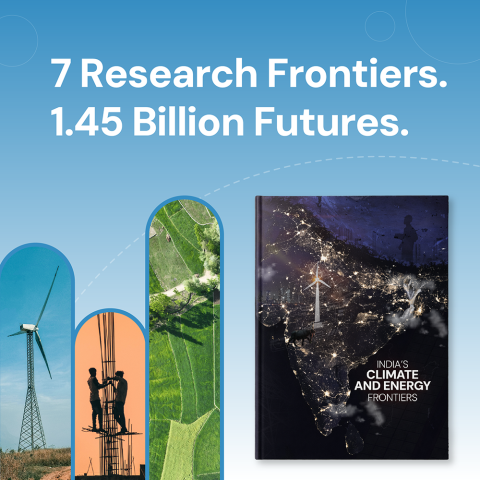
TERI-led chapter in the ICEF report—bringing together over 350 researchers from seven of India’s leading scientific institutions and developed with Schmidt Sciences—calls for integrated modeling frameworks to align climate finance with India’s development and net-zero goals
New Delhi, April 21, 2026: The Energy and Resources Institute (TERI), as a key contributor to the multi-institutional India’s Climate and Energy Frontiers (ICEF) report released today, has spotlighted the critical role of integrated modeling frameworks in unlocking climate finance for India’s low-carbon transition. The report, developed in collaboration with Schmidt Sciences and other leading Indian institutions, brings together insights from over 350 experts to outline priority research frontiers for India’s climate and energy future.
Within this landmark report, TERI contributed the Chapter titled: “Modeling for Climate Finance”, authored by Dr Ritu Mathur, Dr Manish Kumar Shrivastava, and Ms Radha Arora, which presents a compelling case for rethinking how climate finance is assessed, mobilized, and aligned with development goals.
The chapter emphasizes that current modeling approaches are insufficient to capture the complex interplay between climate action, economic growth, and financial systems. It calls for a next-generation integrated modeling ecosystem that brings together:
Such integration is essential to eliminate critical blind spots, such as stranded assets, sectoral disruptions, and financial risks, and to enable evidence-based policymaking for a just and sustainable transition.
Dr Ritu Mathur, Director, TERI, said: “India’s transition to a low-carbon future hinges not just on ambition, but on our ability to align finance with development pathways. Integrated modeling frameworks are essential to bridge this gap, enabling policymakers to understand trade-offs, manage risks, and design strategies that deliver both growth and decarbonization.”
Dr Manish Kumar Shrivastava, Associate Director, TERI, added: “Climate finance is not merely a funding challenge, it is a systemic challenge. Our work highlights the need to connect availability and flows of climate finance with technological transitions and ensuing macroeconomic equilibrium, which have a dynamic relationship with climate-induced physical as well as transition risks.”
Ms Radha Arora, Research Associate, TERI, shared, “By strengthening linkages between climate, economic, and financial models, we can move beyond fragmented analysis toward actionable insights. This is critical for identifying investment priorities, addressing uncertainties, and building confidence among both public and private stakeholders.”
TERI’s contribution calls for a paradigm shift from fragmented modeling approaches to an interconnected ecosystem of analytical tools, enabling India to:
Supported by collaborations with partners such as Schmidt Sciences, this work underscores the importance of cross-disciplinary and cross-institutional approaches in accelerating India’s transition to a resilient, low-carbon economy.