
Headquarters
The Energy and Resources Institute (TERI)
Darbari Seth Block, Core 6C,
India Habitat Centre, Lodhi Road,
New Delhi - 110 003, India
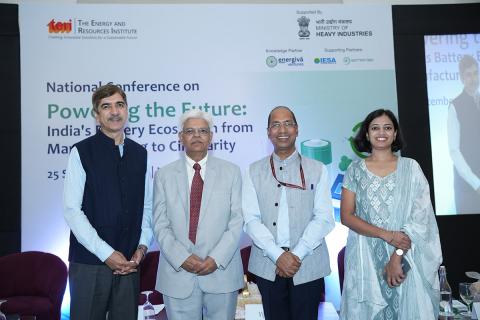
National conference brings together policymakers, industry leaders and research institutions to discuss battery manufacturing, second-life applications, energy storage and circularity
New Delhi, 25 September 2026: The Energy and Resources Institute (TERI) convened a national conference on “Powering the Future: India’s Battery Ecosystem from Manufacturing to Circularity” in New Delhi, bringing together policymakers, industry leaders, researchers and other key stakeholders to deliberate on the opportunities and challenges shaping India’s rapidly evolving battery ecosystem.
The conference examined the battery value chain—from the scale-up of domestic Advanced Chemistry Cell (ACC) manufacturing and the growth of electric mobility to the emerging requirements for battery reuse, repurposing and recycling. Discussions highlighted the need for coordinated action across manufacturing, deployment, second-life applications and end-of-life management to build a resilient, self-reliant and circular battery ecosystem in India.
The conference was inaugurated with a welcome address by Dr Vibha Dhawan, Director General, TERI, followed by opening remarks from Mr A K Saxena, Senior Director, TERI, and Ms Tripti Deshpande, Associate Partner & Lead, Energiva Ventures. Shri Vijay Mittal, Joint Secretary, Ministry of Heavy Industries, Government of India, delivered the keynote address.
Highlighting the importance of an integrated battery ecosystem, domestic manufacturing and circularity, Dr Vibha Dhawan, Director General, TERI, said, “The conversation must also go beyond mobility and explore the potential of second-life applications for EV batteries, which can help maximize their value and utilization beyond their initial use in vehicles.”
Shri Vijay Mittal, Joint Secretary, Ministry of Heavy Industries, Government of India highlighted, “Batteries are central to India’s clean mobility, renewable energy integration, and energy security. MHI is strengthening domestic manufacturing and supply chains while advancing second-life applications, traceability, standards, and recycling for a competitive and circular battery ecosystem.”
Mr AK Saxena, Senior Director, TERI shared, “The focus should be on localizing value creation, rather than just increasing volumes. Batteries should be designed for circularity from day one, while building greater trust in second-life applications by considering their remaining capacity and performance.”
A key highlight of the conference was the launch of TERI’s knowledge-product series, “Beyond Mobility: Unlocking the Second-Life Battery Opportunity.” The series brings together findings from TERI’s study on “Mainstreaming and Scale-up of the Use of Repurposed EV Battery Solutions for Circularity within the EV Supply Chain.” The study explores strategic, policy, regulatory, technical, and market frameworks to enable the mainstreaming and scale-up of repurposed EV battery solutions in India.
The three-volume series examines the global landscape and strategic learnings; India’s market opportunity and ecosystem readiness; and a strategic framework and action plan for scaling the second-life battery ecosystem. A policy brief accompanying the series assesses opportunities and policy measures for creating markets for used EV batteries within emerging Battery Energy Storage System (BESS) programmes.
An interactive Industry Dialogue with policymakers evaluated recent policy and regulatory developments, including the ACC Production Linked Incentive (PLI), PM E-DRIVE and Extended Producer Responsibility (EPR), alongside issues related to battery manufacturing, domestic value addition, BESS demand, emerging technologies and second-life applications.
The subsequent panel discussion on India’s evolving battery manufacturing and circularity landscape brought together representatives from government, industry, research institutions and standards organisations. The discussion covered the evolving battery manufacturing landscape, energy storage applications, battery circularity and recycling technologies, as well as the opportunities and challenges associated with developing a robust domestic ecosystem.
On battery energy storage, emerging technologies and second-life applications, Mr Vinayak Walimbe, Managing Director, IESA, noted, “Enhancing domestic value addition will be important for building a robust and competitive battery ecosystem in the country.”
Dr Kuldeep Rana, Scientist E, MNRE, Government of India shared, “Second-life batteries have significant potential for applications beyond electric mobility, including home appliances, rooftop solar PV systems and UPS systems.”
Ms Sugandhita Wadhera, Senior Manager, BSES Rajdhani Power Ltd added, “State-level capacity planning, stronger payment-security mechanisms, and flexible resources at the distribution downstream will be critical for managing peak demand and building a resilient and responsive power system.”
Ms Neha Jain, Head-Strategy, EV & Innovation, JSW MG Motor India, highlighted, “To enable the development of a commercially viable and evolving second-life battery ecosystem, it is important to establish appropriate price thresholds that can support wider adoption and deployment.”
Mr K N Hemanth Kumar, Director, E-Mobility, International Copper Association India, said, “Cell manufacturing in India is still developing, with significant dependence on imports. There is a need for greater domestic validation and testing of battery materials, including copper foils.”
About advanced battery technologies, research and innovation, Dr Srinivasan Anandan, Scientist F, International Advanced Research Centre (ARCI) noted, “One of the key challenges in advanced cell technology is translating innovations from the laboratory to the factory and industry, particularly in achieving large-scale manufacturing and mass production.”
Dr Manjusha V Shelke, Chief Scientist, CSIR-National Chemical Laboratory (NCL), said, “In the development of lithium-ion batteries, the focus should not simply be on reproducing technologies that have already been developed.”
Mr Priyadarshi Singh, Consultant, WRI, highlighted, “Second-life applications of batteries need to be both affordable and safe to support wider adoption.”
On the key outcomes of the panel discussion and pathways for strengthening the battery ecosystem, Ms Prachi Saini, Associate Fellow, TERI, summed up and said, “Batteries must be viewed as strategic assets, not merely as products. Standardized health assessment, appropriate financing models and the translation of pilot learnings into commercially viable projects at scale will be critical to building a robust and circular battery ecosystem.”
The conference concluded with a call for continued multi-stakeholder engagement to support the development of a competitive, resilient and circular battery ecosystem in India, with greater alignment across policy, technology, industry, standards, financing and end-of-life management.