
Headquarters
The Energy and Resources Institute (TERI)
Darbari Seth Block, Core 6C,
India Habitat Centre, Lodhi Road,
New Delhi - 110 003, India
Three-day national webinar to spotlight technology, finance, skills, and lifecycle interventions to accelerate maritime decarbonization
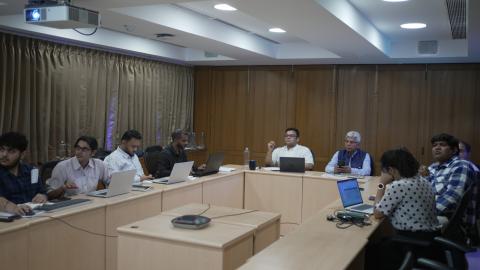
New Delhi, 6 May 2026: The Directorate General of Shipping (DGS), in collaboration with the National Centre of Excellence in Green Ports and Shipping (NCoEGPS) at The Energy and Resources Institute (TERI), has organized a three-day national webinar from 6–8 May 2026 under the Maritime INDIA @ Net Zero initiative to advance stakeholder consultations for the National Green Shipping Policy (NGSP).
The webinar series aims to bring together policymakers, regulators, industry stakeholders, financial institutions, and technical experts to deliberate on actionable pathways for decarbonizing India’s maritime sector across the supply chain.
The opening day set the context for the 3-day deliberations, outlining the objectives, structure, and expected outcomes of the consultation process. It also built on the outcomes of the Maritime INDIA @ Net Zero Multi-Ministerial Workshop held in January 2026, which brought together key stakeholders to translate policy intent into actionable national strategies.
In the Welcome Remarks, Cmde Debesh Lahiri, Advisor, NCoEGPS, set the context by outlining that the National Green Shipping Policy has evolved through a year-long consultative process involving extensive stakeholder engagement, discussions, and deliberations. It began with the release of a consultative document at the Green Shipping Conclave in Mumbai (February 2025), followed by a gap analysis by NCoEGPS and consultations with over 130 stakeholders. The policy continues to remain a dynamic, evolving framework shaped by collaborative inputs.
In the Opening Address, Shri Shyam Jagannathan, IAS, Director General of Shipping emphasized India’s maritime decarbonization journey and highlighted the need for a structured, actionable and future-ready policy framework to guide the sector’s transition. India’s maritime growth must be aligned with sustainability, energy efficiency, regulatory preparedness and global competitiveness, he shared. The address brought out the importance of a ‘whole-of-sector’ approach covering decarbonization of the fleet through energy efficiency, retrofits and alternative fuels; transformation of port ecosystems through electrification, shore-to-ship power and renewable energy integration; strengthening of India’s ship recycling leadership through circular economy practices; mobilization of green finance; use of technology, innovation and digitalization for real-time monitoring and operational optimization and development of skilled human capital to support the green transition. These focus areas are anchored across the seven pillars of NGSP – Green ships, Green Ports, Green Fuels, Green Ship Recycling, Green Finance, Green Technology and Green Skill.
The Director General underlined that NGSP is not merely a policy document, but a strategic pathway for positioning India as a global leader in sustainable maritime operations, in alignment with Maritime India Vision 2030 and Maritime Amrit Kaal Vision 2047”.
The second day will focus on key enablers critical to scaling maritime decarbonization:
The final day will focus on operational and regulatory pathways across vessels, recycling ecosystems, and pollution control:
The webinar will conclude with a closing session summarizing key recommendations and outlining next steps for integrating stakeholder inputs into the draft NGSP.