
Headquarters
The Energy and Resources Institute (TERI)
Darbari Seth Block, Core 6C,
India Habitat Centre, Lodhi Road,
New Delhi - 110 003, India
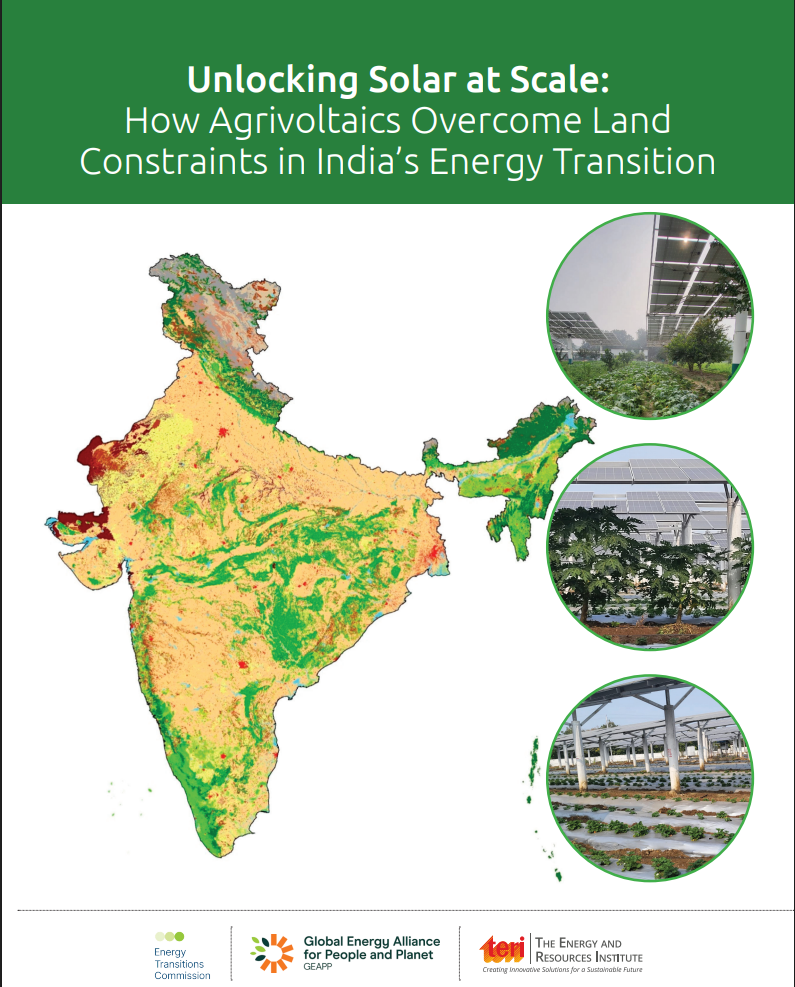
The report,“Unlocking Solar at Scale: How Agrivoltaics Overcome Land Constraints in India’s Energy Transition,” presents a comprehensive assessment of agrivoltaics (AgriPV) as a transformative solution to India’s land-use challenges in scaling solar energy. It demonstrates that by integrating solar photovoltaic systems with agricultural activities, India can significantly expand renewable energy capacity while preserving agricultural productivity and farmer livelihoods.
Using a combination of geospatial analysis and real-world pilot data, the study identifies approximately 47.5 million hectares of land as technically suitable for AgriPV, with a realistic deployment potential of around 16 million hectares. The findings show that AgriPV alone could generate up to 12,775 TWh of electricity, exceeding India’s projected electricity demand by 2050.
Importantly, the report highlights that AgriPV systems can enhance agricultural outcomes, with evidence of 10–20 per cent yield improvements for certain crops, 30 per cent water savings, and improved soil conditions, thereby enabling a sustainable synergy between energy generation and farming.
The study concludes that land availability is no longer a primary constraint for solar expansion in India. Instead, the focus should shift to grid integration, policy frameworks, financing mechanisms, and scalable business models to accelerate deployment. Overall, AgriPV emerges as a key pathway for achieving India’s clean energy targets while supporting climate resilience, rural incomes, and food security.