
Headquarters
The Energy and Resources Institute (TERI)
Darbari Seth Block, Core 6C,
India Habitat Centre, Lodhi Road,
New Delhi - 110 003, India
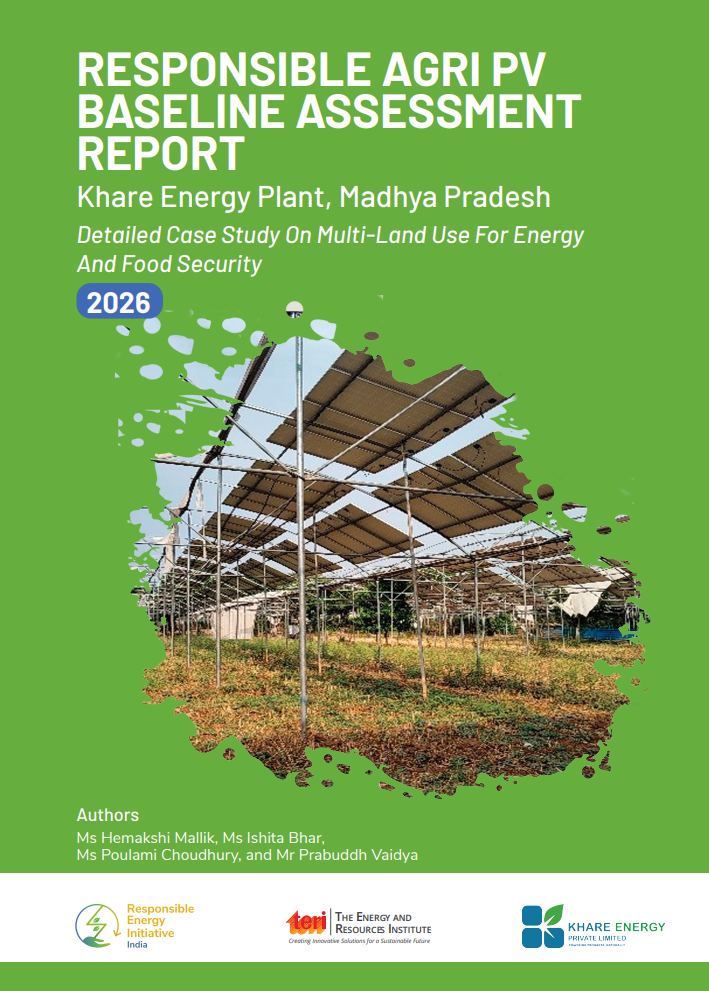
This report, prepared by TERI under the Responsible Energy Initiative (REI) India, assesses a farmer-led agrivoltaics (Agri‑PV) pilot at the Khare Energy Plant in Tikamgarh district, Madhya Pradesh. The study evaluates the project’s energy performance, agricultural outcomes, water use, financial viability, and socio-economic impacts, with the aim of understanding how Agri‑PV can support people‑centric and climate‑resilient renewable energy development in India.
The pilot is a 2 MW sanctioned (1.4 MW operational) solar installation developed under PM‑KUSUM Component A, using elevated and overhead PV structures that allow farming and grazing beneath the panels. The project is owned and operated by a farmer‑cum‑developer model, covering about 5.5 acres of agricultural land. Electricity is sold to the state utility under a 25‑year Power Purchase Agreement at a fixed tariff.
Key findings show that the plant achieves an average capacity utilisation factor (CUF) of 15 per cent, with peak performance exceeding 20% in winter months. The system demonstrates that energy generation can scale successfully while retaining agricultural activity. Crop experiments indicate mixed yield outcomes: some crops (wheat, mustard, maize) experience around 15 per cent yield reduction, while shade‑tolerant crops such as green gram perform better, and wheat quality (grain weight) improves. Importantly, the Agri‑PV system reduces evapotranspiration by 17 per cent. Delivering around 25% water savings, which is crucial in the water‑stressed Bundelkhand region.
Economically, energy sales contribute over 90 per cent of total income, increasing farm income by more than 10 times compared to conventional farming. While Agri‑PV involves higher capital and maintenance costs than ground‑mounted solar, the dual income from energy and agriculture, combined with water savings and livelihood benefits, makes the model socially valuable. However, current tariffs do not fully compensate for these higher costs, affecting financial scalability.
The report concludes that farmer‑centric Agri‑PV systems are viable and socially beneficial, but wider adoption requires improved access to affordable finance, timely grid connectivity, differentiated tariffs, and stronger agricultural extension support. Overall, the Khare Energy pilot provides strong evidence that Agri‑PV can reduce land‑use conflicts, enhance climate resilience, and support inclusive renewable energy expansion in India.