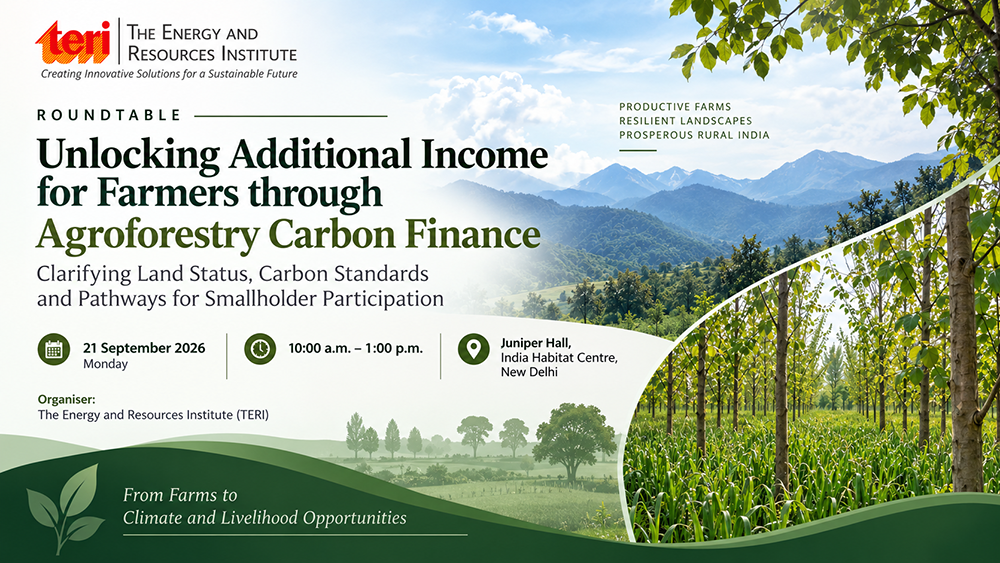
Agroforestry represents one of India’s most compelling opportunities to align climate mitigation with rural income generation. Trees on farms deliver tangible ecological and agronomic co-benefits—such as timber, fruit, fodder, shade, and improved soil and water retention—while sequestering carbon. If designed credibly, carbon finance can serve as a dependable supplementary revenue stream for farmers, particularly when aggregation through Farmer Producer Organisations (FPOs), cooperatives, or allied community institutions lowers transaction costs.
However, translating on-farm tree planting into sustained carbon revenue remains constrained by policy ambiguities, technical bottlenecks, and market volatility. A persistent operational challenge is the conflation of legally classified forest land, statutory forest cover, canopy tree cover, and agroforestry on private agricultural or revenue land. A tree-bearing parcel on revenue land does not automatically constitute forest land. For carbon projects, legal land tenure, revenue records, historical land-use patterns, pre-existing woody biomass, and applicable statutory criteria must be evaluated cohesively.
Concurrently, international carbon accounting standards are evolving rapidly. Benchmarks governing additionality, baseline setting, dynamic baselines, pre-existing woody biomass, permanence, risk of reversal, leakage, high-resolution remote sensing, grouped project architecture, rotational harvesting, and ongoing monitoring are becoming increasingly stringent. A methodology tailored to one agroforestry typology cannot simply be transplanted into another. India therefore requires a differentiated, context-specific framework that safeguards environmental integrity without imposing prohibitive compliance barriers on small and marginal landholders.
This roundtable, on September 21, 2026, is convened as an action-oriented technical and policy dialogue. Moving beyond broad potential, it gathers central ministries, State Forest Departments, carbon crediting programs, Validation and Verification Bodies (VVBs), FPOs, climate investors, project developers, development partners, and technical institutions to delineate viable implementation pathways.
Purpose of the Roundtable
Central Proposition: Carbon finance must serve as an additional income stream for farmers, rather than an additional layer of procedural complexity.
- Land Classification Clarity: Demarcate clear criteria to distinguish agroforestry on agricultural/revenue land from classified forest land for carbon project screening, eligibility, and risk mitigation.
- Contextual Standard Selection: Evaluate how major international and emerging standards (such as Verra, Gold Standard, and Isometric) can be applied contextually across diverse Indian agroforestry typologies, avoiding one-size-fits-all assumptions.
- Smallholder Inclusion Pathways: Establish viable pathways for small and marginal farmers through institutional aggregation, minimized upfront capital burdens, unencumbered carbon rights, and equitable benefit-sharing architectures.
- Methodological Rigour: Resolve key technical approaches for baseline determination, accounting of pre-existing biomass, additionality, rotational harvest management, permanence buffers, and digital Measurement, Reporting, and Verification (MRV).
- Stakeholder Role Mapping: Define distinct institutional mandates across government agencies, State Forest Departments, FPOs, investors, project proponents, and VVBs from pre-feasibility through issuance and farmer disbursement.
- Pilot Demonstration: Identify two to three state-level pilot initiatives to field-test a common screening and implementation framework across contrasting agro-ecological zones and land-tenure systems.
Key Questions for the Panel
- Land Status and Eligibility: What verifiable documentation must establish that a parcel is agricultural/revenue land rather than forest land, and how should statutory cadastral records be reconciled with satellite-observed tree cover?
- Existing Biomass and Additionality: How should land parcels with scattered or low-density pre-existing trees be accounted for, and under what conditions can incremental carbon gains above a non-zero baseline be credited?
- Carbon Standards and Typologies: Which Indian agroforestry models are best aligned with specific crediting standards, and what are the critical trade-offs regarding baseline setting, permanence, rotational harvesting, and monitoring protocols?
- Smallholder Project Economics: What is the viable threshold scale for aggregated agroforestry projects, and what financing instruments can absorb validation, registration, and initial MRV costs prior to first credit issuance?
- Farmer Safeguards and Equity: How should legal carbon rights, revenue-sharing cascades, contract tenures, tree harvest permissions, land title autonomy, and grievance mechanisms be structured to protect and empower primary producers?
MRV and Verification Standards: What constitutes an acceptable minimum evidence package that integrates digitized cadastral records, historical satellite baselines, stratified field inventories, plantation logs, and ongoing digital monitoring?
- Enabling Governance: What policy clarifications, spatial datasets, or facilitative guidelines can the Ministry of Environment, Forest and Climate Change (MoEFCC) and State Forest Departments issue without assuming proponent-level project liabilities?
- Scalability and Pilots: Which states and production systems offer the most viable conditions for immediate pilots, and what institutional bridge is required to scale these pilots into a standardized national practice?
Expected Outcomes
- Land Eligibility Decision Framework: A standardized screening protocol to decisively differentiate agroforestry on private agricultural/revenue land from statutory forest land for carbon developers, registries, and regulators.
- Context-Specific Standards Matrix: A comparative matrix mapping carbon standards and methodologies to predominant Indian agroforestry systems (covering zero-baseline, non-zero-baseline, rotational woodlots, and grouped smallholder setups).
- Harmonized Minimum Evidence Package: An agreed dossier template covering cadastral validation, baseline documentation, and digital/field MRV requirements recognized by VVBs, standards, and state authorities.
- Farmer-Centric Principles: A consensus charter governing aggregation structures, pre-financing models, carbon title ownership, risk-sharing, and verifiable benefit-distribution mechanisms.
- Pilot Roadmap & Working Group: Formal identification of two to three state-level pilot jurisdictions and the constitution of a targeted technical working group to synthesize the dialogue into a actionable Policy & Technical Roadmap.