Headquarters
The Energy and Resources Institute (TERI)
Darbari Seth Block, Core 6C,
India Habitat Centre, Lodhi Road,
New Delhi - 110 003, India
India’s pathway to Net-Zero by 2070 hinges on scaling renewable energy, supported by flexible and reliable grid systems. Gujarat continues to lead this transition through ambitious Battery Energy Storage System (BESS) initiatives, including multi-phase utility-scale tenders designed to enhance grid stability, enable higher renewable integration, and manage peak demand. These efforts underscore the state's role as a frontrunner in adopting the technology necessary for a resilient and modern energy landscape.
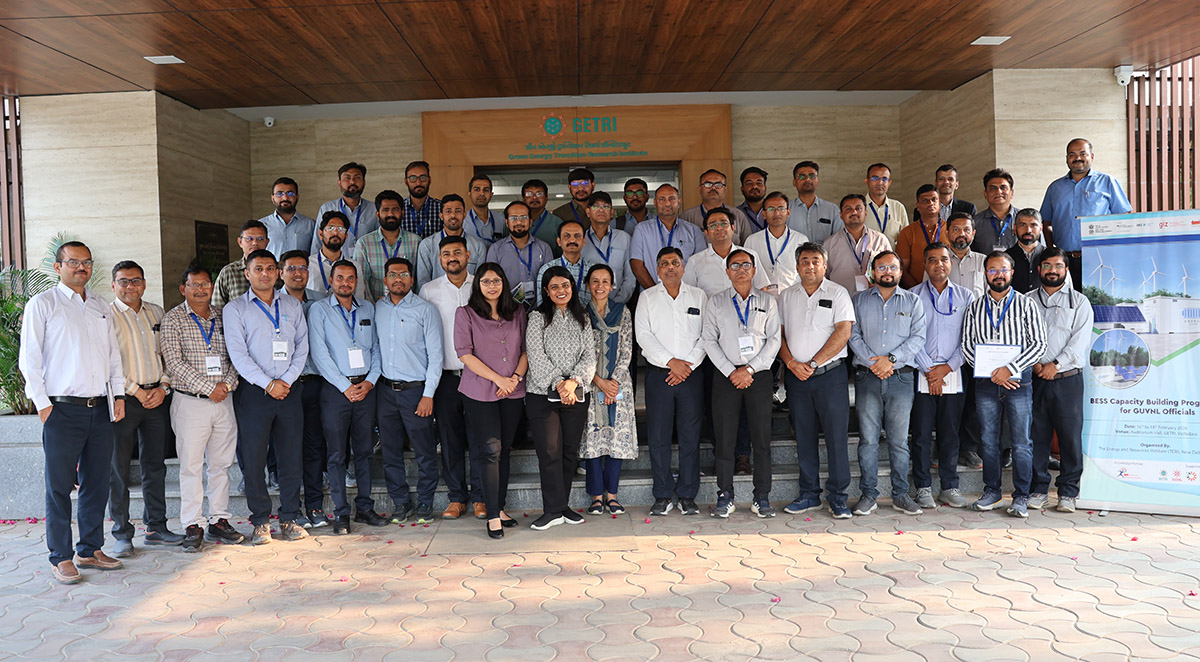
In support of this national effort, the StoREin project—implemented by GIZ India under the International Climate Initiative, in partnership with the Ministry of New and Renewable Energy (MNRE), The Energy and Resources Institute (TERI), Fraunhofer Institute for Energy Economics and Energy System Technology, Indian Institute of Technology Bombay, and World Resources Institute India—conducted a three-day intensive capacity-building programme. The initiative was specifically tailored for officials from Gujarat Urja Vikas Nigam Limited (GUVNL), its subsidiaries, and the Green Energy Transition Research Institute (GETRI).
Held from 16–18 February 2026 at the Green Energy Transition Research Institute in Vadodara, the programme brought together stakeholders from government, utilities, and research institutions, highlighting a robust national–state collaboration in advancing energy storage. Participants gained deep technical insights into energy storage fundamentals, BESS design and safety protocols, grid integration strategies, and the evolving regulatory and implementation frameworks. This comprehensive curriculum ensures that utility officials are equipped with the expertise to manage complex energy transitions.
The programme concluded with a certificate ceremony and a strategic field visit to the 180 MW/360 MWh Sanand BESS project. This visit offered participants vital hands-on exposure to utility-scale storage operations, bridging the gap between theoretical frameworks and real-world application. By integrating site-level learning with technical training, the StoREin project continues to strengthen the capacity of state utilities to deploy and scale storage solutions effectively.