India must stop treating mangrove restoration as a plantation exercise and begin financing it as climate-resilient coastal infrastructure.
Every July 26, mangroves are celebrated for doing several jobs at once. They soften waves, shelter fish, hold shorelines together and lock away carbon in biomass and waterlogged soil. Yet they are still funded through an older model of conservation: identify a site, plant saplings, report the area covered and move to the next project. This is inadequate for a country whose coastline has been reassessed at 11,098.81 km. The India State of Forest Report 2023 records 4,991.68 sq km of mangrove cover, a net decline of 7.43 sq km from 2021. These numbers do not suggest that India lacks programmes. They show that planting and durable restoration are not the same thing.
The central problem is financial design. Mangroves require money before planting, during restoration and for years afterwards. Site assessment, tidal-channel repair, nurseries, protection, monitoring and course correction all cost money. Public schemes can fund activities, but ecological recovery does not follow annual budget cycles. Blue carbon finance can help bridge this mismatch, provided it is used for the right purpose. Mangroves store carbon not only in visible vegetation but also below ground, where oxygen-poor conditions slow decomposition. Preventing the loss of an existing mangrove and restoring tidal conditions in a degraded site can therefore create measurable climate benefits.
This makes carbon markets relevant, though not as a substitute for conservation expenditure. A credible project must establish what would have happened without intervention, quantify additional emission reductions or removals, monitor them over time and account for risks such as erosion, cyclones, and future loss. This discipline can shift attention from the number of seedlings planted to the condition of the ecosystem that survives.
That shift is essential for degraded mudflats. A bare intertidal area is not automatically an invitation to plant. Some mudflats are valuable habitats; others cannot support mangroves because tidal exchange, elevation or sediment conditions have changed. In such places, repairing hydrology may matter more than plantation. Finance should reward restored ecological function, not green coverage imposed on every available patch.
India’s Mangrove Initiative for Shoreline Habitats and Tangible Incomes, or MISHTI, provides a useful public platform. The government has set a target of restoring 54,000 hectares by 2028. Official reporting says 4,536 hectares were restored in 2025 and 22,560 hectares of degraded areas identified for future work. The next step should be to use this public effort to attract longer-term capital rather than construct a parallel market mechanism.
A practical financing model would have three layers. Public funds should pay for mapping, ecological assessment and early restoration, where risks are highest. Concessional or corporate capital can finance implementation and absorb the wait before verified outcomes emerge. Carbon revenue, when generated, should pay for continued protection, scientific monitoring and local performance over the project’s life. There is also a case for bringing in beneficiaries who rarely appear in mangrove budgets. Ports, coastal industries, tourism assets, municipal bodies and insurers all gain when shorelines are more stable and storm damage is reduced. They should participate in district- or estuary-level resilience funds.
Carbon credits can provide one revenue stream, while adaptation finance, corporate contributions and disaster-risk financing provide others. Depending entirely on credit prices would leave restoration exposed to market volatility. Blue carbon should be treated as part of a financing stack, not as a single source expected to pay for everything. This approach also gives coastal communities a more concrete role than the usual promise of “participation”. Fishers, honey collectors, women’s groups and local youth know where tidal water once flowed, which creeks are silting, where seedlings repeatedly fail and how fishing patterns are changing. Their knowledge should shape project design, while long-term stewardship should be treated as a paid ecological service.
Payments need not wait for the first carbon-credit issuance. Restoration wages can be followed by annual contracts linked to seedling survival, protection of natural regeneration, maintenance of tidal channels, and reporting of cutting or erosion. Part of later carbon revenue can replenish village-level resilience funds. This connects money to work performed and outcomes maintained, rather than offering communities an uncertain dividend several years in the future. It also makes benefit-sharing measurable: not simply a percentage written into a project document, but a continuing payment for maintaining a public ecological asset.
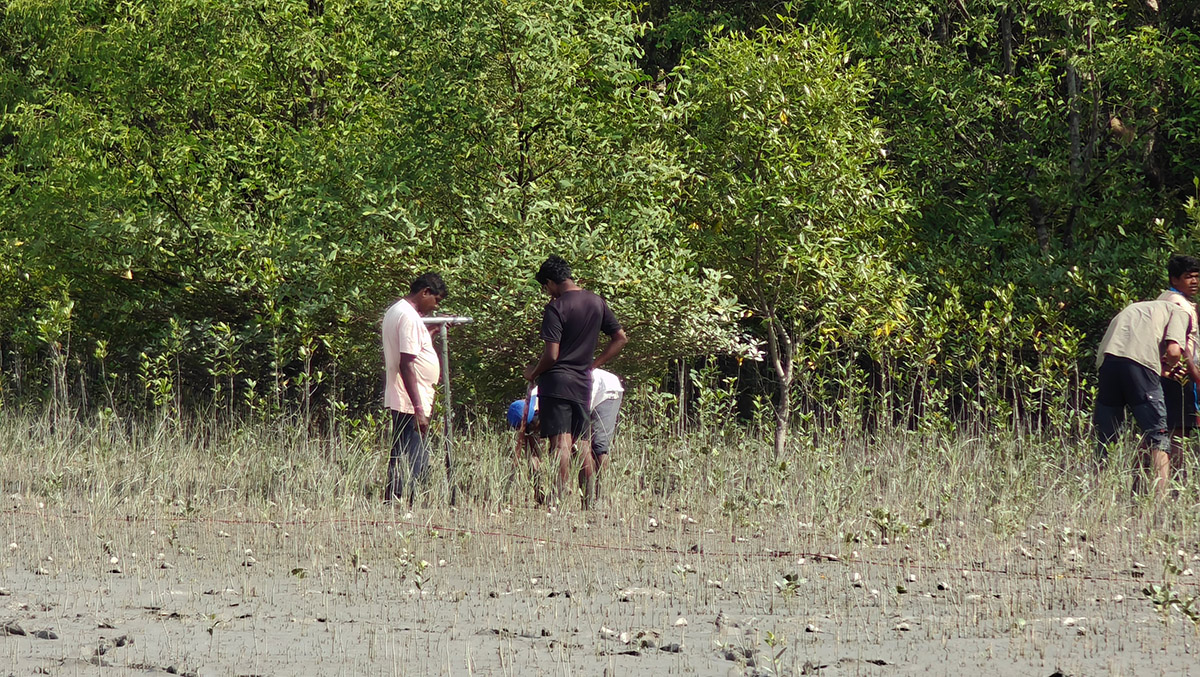
Technology can make such arrangements credible. Satellite data can track changes in extent and canopy condition; field sampling can measure biomass and soil carbon; digital records can disclose expenditure and credit issuance. But technology should verify restoration, not create an illusion of precision. Mangrove carbon varies sharply by location, and conservative accounting is more valuable than inflated estimates that later collapse under scrutiny.
TERI’s work on mangrove carbon finance in the Sundarbans and Gujarat is engaging with precisely these questions: how to establish credible baselines, assess carbon stocks, distinguish project intervention from routine activity and link project finance with long-term coastal management. The wider lesson is that blue carbon is not merely a new class of credit. It is a way to organize patient finance around ecological outcomes.
This World Mangrove Day, India does not only need more plantations. It needs investible restoration plans, long-duration monitoring and multiple buyers for the public value mangroves create. A mangrove is simultaneously a carbon store, a fish nursery and protective infrastructure. Financing it as only one of these things will always undervalue it. Financing all three may finally give restoration the time it needs to become real.
(All photos by the author)