
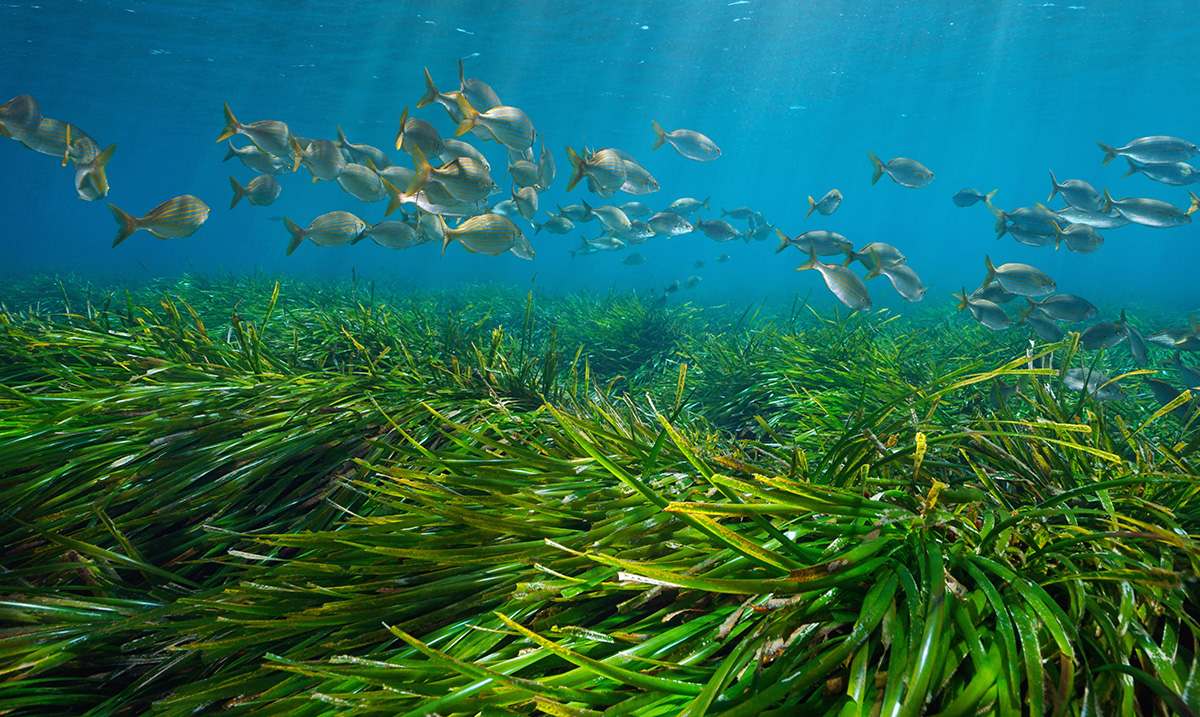
Observed each year on 1 March, World Seagrass Day was officially designated by the United Nations General Assembly in May 2022 to highlight the critical importance of seagrass ecosystems for marine biodiversity and climate stability.
A Quiet Climate Solution
The global climate discourse is increasingly turning toward ecosystems that lie beneath shallow coastal waters. Seagrass meadows, long overshadowed by forests and mangroves in policy thinking, are emerging as one of the most powerful yet underutilised natural climate assets. For India, a maritime nation with an extensive coastline and highly climate-vulnerable coastal communities, the moment demands not just recognition but purposeful policy action.
Blue carbon ecosystems, including mangroves, seagrasses, salt marshes and coastal wetlands, are now widely acknowledged as high-impact nature-based solutions. They store carbon efficiently in both biomass and long-lived sediments while strengthening coastal protection, supporting fisheries and sustaining livelihoods. India’s long coastline and diverse coastal geomorphology position the country uniquely to scale ecosystem-based climate finance. Yet within this broader blue carbon framework, seagrass ecosystems remain conspicuously underrepresented in national climate and coastal planning.
Why Seagrass Matters for India
The policy neglect of seagrass is particularly striking because these underwater meadows deliver a rare combination of climate and development benefits. Seagrasses function as highly efficient carbon sinks and improve water quality by trapping nutrients and pollutants. They also provide critical nursery grounds for commercially important fish species. For a climate-vulnerable country, their role in attenuating wave energy and stabilising shorelines is equally significant.
For millions living along India’s coasts, these ecological functions translate directly into food security, livelihood stability and disaster risk reduction. Healthy seagrass systems strengthen nearshore fisheries, protect coastal infrastructure and enhance ecosystem resilience at a time when climate variability is intensifying.
India possesses significant seagrass habitats in the Gulf of Mannar, Palk Bay, Lakshadweep and the Andaman and Nicobar Islands. However, unlike mangroves, these ecosystems have not yet been systematically integrated into carbon finance strategies, national greenhouse gas accounting or coastal investment frameworks. The gap reflects not a lack of potential but the absence of coordinated mapping, monitoring and policy prioritisation.
The Carbon Finance Window
The global carbon market landscape is evolving rapidly in favour of high-integrity nature-based solutions. Blue carbon projects, particularly those involving coastal wetlands and seagrasses, are increasingly valued for their permanence, additionality and biodiversity co-benefits. This shift presents India with a timely opportunity to mobilise climate finance while strengthening coastal resilience.
Seagrass-based carbon projects can generate verified emission reductions through both avoided degradation and active restoration. For coastal districts facing rising climate risks and livelihood pressures, such projects offer a pathway that aligns ecological restoration with community income streams. However, without a structured national push, India risks missing the current momentum in voluntary carbon markets.
From Pilots to Policy
What India now requires is a transition from scattered pilot initiatives to a coherent national framework. Establishing a dedicated National Blue Carbon Mission would provide the necessary institutional anchor. Such a mission must explicitly incorporate seagrass ecosystems alongside mangroves and salt marshes, ensuring that coastal carbon assets are assessed, monitored and valued within a unified policy architecture.
Integration with State Action Plans on Climate Change and coastal zone management frameworks will be critical for mainstreaming blue carbon into climate governance. At the same time, regulatory clarity around coastal restoration, carbon rights and benefit sharing will help attract credible private and multilateral investment.
Scientific credibility will determine market confidence. India must prioritise high-resolution seagrass mapping through satellite observations, drone-based surveys and underwater assessments. Robust measurement, reporting and verification systems that combine field-based biomass and soil carbon estimation with advanced modelling tools are essential for generating high-integrity credits.
Communities at the Centre
No blue carbon strategy can succeed without the meaningful participation of coastal communities. Fishers and local institutions remain the primary stewards of nearshore ecosystems. Benefit-sharing mechanisms that channel carbon revenues into local livelihoods, habitat protection and sustainable fisheries will determine the durability of these initiatives.
India’s experience with community-linked mangrove restoration already demonstrates that when economic incentives align with ecological goals, outcomes improve significantly. Seagrass conservation must build on this lesson, embedding social equity alongside carbon outcomes.
A Blue Economy Imperative
There is also a compelling strategic case for embedding seagrass conservation within India’s emerging blue economy vision. Coastal infrastructure expansion, dredging, pollution and unregulated marine activity continue to place shallow-water ecosystems under pressure. Unless seagrass habitats are formally recognised as climate-critical natural capital, incremental degradation will continue largely unnoticed.
Policy convergence across climate, fisheries, shipping and coastal development sectors is therefore essential. Recognising seagrass meadows as productive ecological infrastructure rather than peripheral habitats would mark a decisive shift in coastal policy thinking.
A Leadership Opportunity
India stands at an inflection point. Rising global demand for credible nature-based carbon credits coincides with growing climate risks along the country’s coastline. With strong scientific capability, expanding carbon market engagement and extensive coastal ecosystems, India has the ingredients to emerge as a leader in blue carbon innovation.
World Seagrass Day should therefore serve as more than a symbolic observance. It should act as a policy trigger. Protecting and restoring seagrass meadows is no longer a niche conservation concern. It is a strategic climate, economic and coastal resilience imperative. If India moves with scientific rigour and institutional urgency, its underwater meadows could become one of the country’s most valuable climate assets in the decades ahead.