
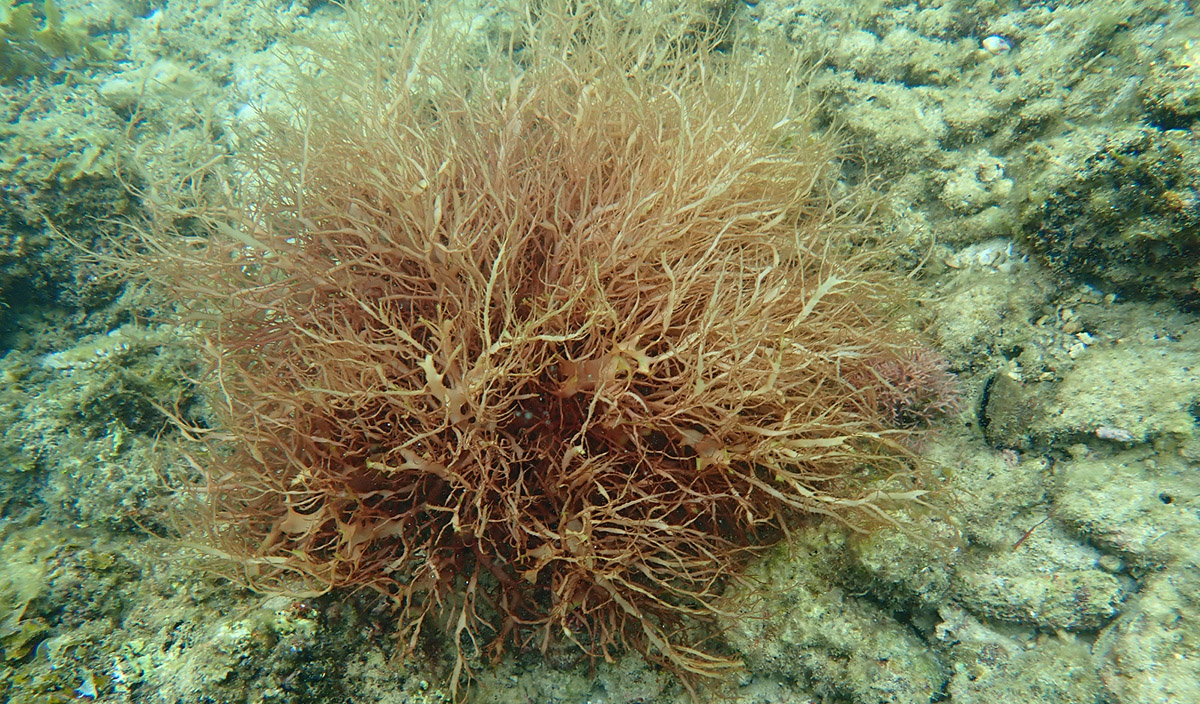
Unlike conventional blue carbon's ecosystems like mangroves, salt marshes, seagrass meadows, seaweed largely occupies rocky, high-energy intertidal and subtidal substrates where there is no accumulating sediment column.
Mechanistic pathway
Unlike conventional blue carbon's ecosystems like mangroves, salt marshes, seagrass meadows, seaweed largely occupies rocky, high-energy intertidal and subtidal substrates where there is no accumulating sediment column. Therefore, carbon removed in the form of dissolved inorganic carbon (DIC) by the live biomass has no immediate grounding reservoir for storage, instead it is either exported off-site into a depositional environment of the ocean (Fig. 1) or used for different commercial purposes (food and beverages, animal feed, etc.). This single structural fact undermines the analogy to mangrove or seagrass blue carbon and is the biological root of the accounting paradox.
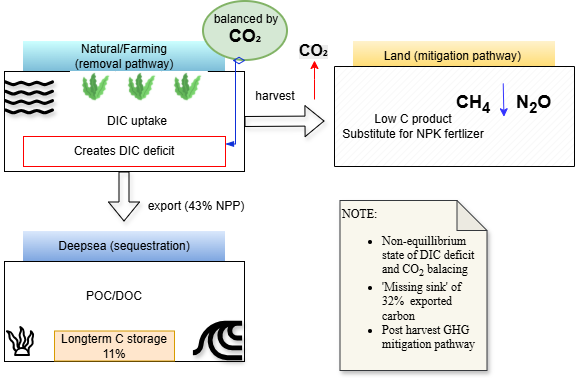
Fig. 1. Pictorial depictions of carbon pathways of seaweeds within the land-inshore-and offshore continuum. The mechanistic pathway suggests ‘removal’ of dissolved inorganic carbon (DIC) from water column by seaweeds followed by its use as ‘mitigation’ services (greenhouse gases) via low carbon product development and deep sea ‘sequestration’ of the unharvested biomass through tidal export in the form of dissolved and particulate organic carbon (DOC and POC) (image credit: R.Ray).
As stated, seaweeds fix DIC from seawater, primarily as bicarbonate (HCO3-) locally drawing down CO2 or HCO3- concentrations. Atmospheric CO2is only actually removed if the DIC deficit is replenished by CO2 diffusing in from the air, and air-sea equilibration is slow ranging from days to years, shifting further as seaweed biomass grows, so true equilibrium is rarely attained (Gallagher et al., 2022). Even where equilibration occurs, the resulting air-sea flux is smaller than the original DIC deficit, because other processes also draw on the inorganic carbon pool, e.g., calcification (Smith et al., 1989) and upwelling of older, millennial-age DIC among them. This makes the link between measured DIC uptake and actual atmospheric removal largely uncertain.
The second pathway of mitigation services involves post-harvest use of seaweed biomass displacing carbon-intensive products like aqua feeds, thereby delivering substitution benefits that indirectly avoid emissions (Duarte et al., 2021). For instance, seaweed-based soil additive can be a potential substitute of nitrogen-phosphorous-potassium (NPK) fertilizer reducing N₂O emissions or cattle feed with Asparagopsis sp. Significantly lowers CH4 emission. A conservative seaweed restoration on 4819 ha of available Indian coastal waters could offset ~0.17 million tonne CO₂e through seaweed-derived products (stock: 183 tonne ha⁻¹ dry weight, offset factor: 961 kg CO₂e per t dry biomass, extraction efficiency ~20%; Johnson et al., 2020; Gao et al., 2020). Despite this short-term climate mitigation services, their contribution to carbon neutrality remains uncertain in the absence of comprehensive life cycle assessments (LCA) during sample processing, transport, and end use.
The third pathway is sequestration where fraction of net primary production (NPP) that is not harvested but exported as particulate and dissolved organic carbon (POC/DOC), followed by remineralization of the labile pool during transport (refractory DOC remains within the water column), and finally buried under marine sediment for centuries. However, the permanence of this burial remains poorly constrained, as most existing studies focus on shallow sediments with limited potential for stable carbon retention. Furthermore, quantifying long-term sequestration requires core dating proximal to seaweed farms, which is both technically demanding and resource intensive. Global synthesis identified a "missing sink" of 32% carbon either respired, grazed, or degraded after (Fig. 1).
Implication in carbon market
Verified credits require demonstrable additionality, permanence, and measurable atmospheric drawdown. Seaweed based carbon frameworks exist (such as M0172 and Gold Standard), but Verra has not yet approved a seaweed methodology. Dumping of seaweed under the seabed and claiming for permanence credit without peer-reviewed evidence or regulatory oversight raises serious concerns over the health of benthic communities. (Fujita et al., 2023). Hence, regulators have responded in markedly different ways. Japan's J-Blue Credit scheme, run by the Japan Blue Economy Association since 2020, has taken the most direct approach. It now certifies wild and farmed seaweed beds using a removal-coefficient method built on net primary production. Australia is trying something similar but without direct removal approach. Despite that, majority of worlds nations are working around the same underlying problem as illustrated in Figure 1, that there is no settled methodology for verifying where exported seaweed carbon ends up.
Way forward
Closing this gap will require targeted work at pilot scale in a focussed scientific direction:
- Estimating spatio-temporal changes of air-sea CO2 flux and net ecosystem production (NEP) through baseline (no seaweed, perhaps only phytoplankton) and project scenario (seaweed and phytoplankton)
- Comparison of these measurements relative to the local alternative or degraded state
- Integration of carbon mitigation estimates into deployable low-cost MRV (Monitoring, Reporting, Verification) frameworks.
- Coupling harvest-based mitigation accounting (fertiliser substitution, CH₄/N₂O avoidance) with removal accounting so the two are not double-counted.
References
- Duarte, C. M., et al., 2021. A seaweed aquaculture imperative to meet global sustainability targets. Nature Sustainability, 5, 1-9.
- Fujita, R. et al. Seaweed blue carbon: Ready? Or Not? Marine Policy 155, 105747
- Gallagher, J.B., et al., 2022. A Re-evaluation of Wetland Carbon Sink Mitigation Concepts and Measurements: A Diagenetic Solution. Wetlands 42.
- Gao, et al., 2020. Using macroalgae as biofuel: current opportunities and challenges, Bot. Mar. 63, 355–370.
- Hurd, C.L., et al., 2023. Air-sea carbon dioxide equilibrium: Will it be possible touse seaweeds for carbon removal offsets?. Journal of Phycology. 2024;60:4–14.
- Johnson, B., et al. 2020. "Preliminary estimates of potential areas for seaweed farming along the Indian coast." Marine Fisheries Information Service, Technical and Extension Series 246, 14-28.