
Headquarters
The Energy and Resources Institute (TERI)
Darbari Seth Block, Core 6C,
India Habitat Centre, Lodhi Road,
New Delhi - 110 003, India
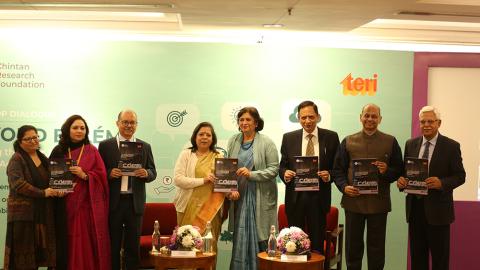
Experts gather to unpack COP30 decisions and assess implications for India’s climate pathway.
New Delhi, 9 December 2025: The Energy and Resources Institute (TERI) and The Chintan Research Foundation (CRF) jointly organized a high-level Post-COP Dialogue titled, “Beyond Belém: Charting the Next Phase of Global Climate Action” at the India Habitat Centre today. The discussions brought together senior policymakers, climate negotiators, researchers, and experts to assess the implications of COP30 outcomes and identify pathways for further strategy for developing countries.
The Dialogue provided an in-depth examination of the decisions adopted—particularly those related to mitigation ambition, adaptation indicators under the Global Goal on Adaptation (GGA), the Baku-to-Belém Roadmap on climate finance, and the establishment of a Global Mechanism on Just Transition.
The Dialogue also saw the launch of a COP30 debriefing paper, “The Belém Package: Recasting Ambition, Equity, and Finance in the Next Phase of Climate Action,” offering a structured assessment of the negotiations and their implications for developing countries.
Introducing the event, Dr Debajit Palit, Centre Head, Centre for Climate Change & Energy Transition, Chintan Research Foundation, emphasized the need for evidence-based dialogue to navigate the widening ambition–implementation gap. He said, “For developing countries, the way forward lies in translating COP outcomes into strategies that strengthen resilience, support inclusive development, and accelerate technological transformation. Coming years will be crucial for demonstrating tangible progress that amplifies the voice of the Global South.”
In her opening remarks, Dr Vibha Dhawan, Director General, TERI, underlined the significance of COP30. “This year’s COP in Belém was significant as Brazil brought the process back to the Amazon and urged the world to move from commitment to implementation. However, the implementation pathway initiated by the COP30, on finance, adaptation, and mitigation must be non-prescriptive, just, fair and equitable. The decision text captures this spirit. The task ahead for negotiators and policy makers is to translate this spirit into action, through cooperation not coercion like unilateral trade measures. We must resist narrative shifts that erode equity and ensure that ambition does not shift burdens unfairly onto those who have contributed the least but face the highest risks.”
Mr Shishir Priyadarshi, President, CRF, extending the context of discussion to economic cooperation and trade, stressed the importance of placing India at the centre of the evolving trade–climate interface. “India must be at the table where trade and climate meet. Climate policy will only work when it is connected to trade and economic policy. For India and the Global South, climate action is not a choice between green and growth—it is about fairness and equity.”
Session Highlights
Session 1 – Interpreting COP30: Implications for Global Mitigation and Adaptation Targets
Moderated by Mr RR Rashmi, Distinguished Fellow, TERI, and India’s former principal negotiator for climate change negotiations under the UNFCCC, the discussion unpacked COP30 decisions on global mitigation efforts and the newly adopted adaptation indicators.
Ms Pooja Sehwag, Research Associate, CRF, provided an overview of the COP30 outcomes setting the context for deliberations.
Ms Leena Nandan, Former Secretary, MoEFCC welcomed the inclusion of both nature-based and technology-driven CO₂ removal, noting that initiatives such as Mission LiFE and grassroots efforts like Ek Pedh, Maa Ke Naam reflect India’s commitment to community-centred climate action. She said, “Climate justice remains sidelined despite its centrality to equitable climate action. Trade must not become a tool for imposing climate pressures. India has consistently argued against unilateral trade measures, and it is encouraging that LMDCs and the BASIC group secured consensus on this.”
Prof. Ajay Mathur, School of Public Policy, IIT-Delhi, observed that COP30 marked a definitive shift from expectations to delivery. “Adaptation saw substantive progress with 59 new indicators. The challenge now is building national systems, strengthening bottom-up approaches, and enhancing public awareness so countries can meaningfully use these indicators,” he said.
Mr Kirtiman Awasthi, Senior Advisor and Programme Head, GIZ-India, underscored the urgency emerging from escalating climate extremes. “Bottom-up adaptation needs strong knowledge systems, technology, multi-stakeholder governance, and robust monitoring and evaluation. The GGA now provides a measurable framework, but local indicators must align with it,” he shared.
Ms Suruchi Bhadwal, Senior Fellow and Programme Director, TERI, called for the need to go beyond the local application of indicators on the Global Goal on Adaptation and identify indicators that track adaptation issues that operate at global scale such as food security. She added that, “We need to understand specific climate risks and vulnerabilities, to determine adaptation strategies. Adaptation strategies must percolate to the local level to address specific risks and prioritize social protection, health, and food security for an equitable transition.”
Ms Ruchika Drall, Deputy Secretary, MoEFCC, remarked, “A two-year work programme has now begun to examine Article 9.1 in greater depth, and it is essential that we move beyond a narrow view of development finance to clearly differentiate between the various sources of climate finance. The GGA indicators adopted at Belém are well aligned with India’s position asking for flexibility in application at national level. Importantly, the platform also enables discussions on non-tariff barriers introduced under the guise of climate action. Such measures risk undermining comparative advantage, which is why India strongly advocated for placing Unilateral Trade Measures on the agenda.”
Concluding the session, Mr RR Rashmi, Distinguished Fellow, TERI, noted that, “Building trust and consensus is important for substantial progress. A development plus approach to climate action and cooperation, including on finance will benefit meaningful implementation.”
Session 2 – Financing the Transition: COP30 Outcomes on Climate Finance
The second session examined the shifting landscape of climate finance, with a focus on access, equity, and developing-country needs.
In his framing presentation, Dr Manish Kumar Shrivastava, Senior Fellow, TERI, explained the scale of global financial needs. “An estimated USD 6.3 trillion per year will be required by 2030. Mobilizing climate finance will depend on the five Rs—replenishing, rebalancing, rechannelling, revamping, and reshaping—of the Baku-to-Belem Roadmap to 1.3 Trillion. The 5Rs will be the next key agenda of negotiations.” He stressed the importance of codifying quantitative public-finance floors under the NCQG and defending CBDR-RC when implementing Article 2.1(c), especially for developing countries’ access to finance.
Ambassador Manjeev Singh Puri, Distinguished Fellow, TERI, explaining the big picture, highlighted the geopolitical realities shaping climate finance. “Climate negotiations remain a power game, and countries like India face greater vulnerability. India is adapting and acting responsibly, but historical emitters cannot look away. Attracting foreign funding is essential, as domestic financial capacity is far from sufficient.”
Dr Ashish Chaturvedi, Head, Climate & Environment, UNDP India, underscored the importance of distinguishing between funding streams. “We must be clear about the nuances between Article 9 and Article 2.1(c) and ensure complementarity rather than competition. Public finance must prioritize loss and damage and the mitigation–adaptation nexus, while implementation pathways need accountability without imposing undue burden on developing countries,” he noted.
Ms Neha Kumar, Head, South Asia, Climate Bonds Initiative, emphasized the geopolitical complexity of climate finance. She pointed that, “In a fragmented world facing multiple crises, climate change and climate finance must be strategic pillars of economic development.” She noted that Brazil’s Tropical Forests Forever Facility introduces a novel mix of concessional and market finance that can directly support tropical forest conservation and channel funds to indigenous communities.
Mr Saliem Fakir, Executive Director, Africa Climate Foundation, reinforced that climate progress increasingly happens both inside and outside the UNFCCC. He said, “Climate action cannot wait for COP processes alone. Decarbonization must stay on the global agenda, and climate action must be integrated with economic development. Even amid shifting geopolitics, collective global interests must guide our response.”
The Dialogue concluded with a shared commitment to deepen collaboration, strengthen multilateralism, and translate COP30 outcomes into tangible pathways for a just, resilient, and equitable climate future.