
As 2025 draws to a close, The Energy and Resources Institute (TERI) reflects with gratitude on a year of cutting-edge research, institutional growth, and policy leadership that further entrenched its role as a global sustainability driver. TERI made major strides — launching the Centre of Excellence for Energy Transition at its Institute of Energy Transition in Hyderabad, deepening its Himalayan outreach through a new Centre for Himalayan Studies in partnership with Guwahati University, and convening a national dialogue on smart grid and energy storage integration. On the policy front, TERI published several key policy briefs: from Shifting Gears Towards Cleaner Air on urban fleet modernization in India’s million-plus cities, to a COP30-focused brief calling for reform in multilateral climate governance. The Institute also advanced industrial decarbonization via in-depth technology briefs on low-emission ironmaking and energy efficiency in steel. As it charts into its next chapter, TERI remains steadfast in driving just, inclusive, and science-backed climate action.

The 24th edition of the World Sustainable Development Summit (WSDS), organized by The Energy and Resources Institute (TERI), commenced today in New Delhi. Themed 'Partnerships for Accelerating Sustainable Development and Climate Solutions,' WSDS 2025 brings together global leaders, policymakers, industry experts, and other stakeholders to foster collaborations and drive solutions for some of the most pressing environmental challenges.
Leaders call for urgent action on sustainability and climate solutions
The welcome address was delivered by Mr. Nitin Desai, Chairman, TERI. This was followed by the theme address delivered by Dr. Vibha Dhawan, Director General, TERI. Delivering the inaugural address, Shri Bhupender Yadav, Hon'ble Minister for Environment, Forest and Climate Change, formally opened the Summit. His Excellency Brigadier (Retd.) Mr. Mark Phillips, Prime Minister of Guyana, delivered the keynote address, followed by a keynote address from Her Excellency Ms. Marina Silva, Minister of Environment and Climate Change, Brazil.
Following the inaugural session, the Sustainable Development Leadership Award (SDLA) was presented to His Excellency Dr Bharrat Jagdeo, Hon’ble Vice President of Guyana, and Her Excellency Ms Marina Silva, Hon’ble Minister of Environment and Climate Change, Brazil, for their exceptional contributions to sustainability and climate action. The SDLA, TERI’s highest recognition for outstanding global leadership in sustainable development, honours individuals who have made a significant impact in environmental conservation, climate action, and sustainable policymaking.

The Energy and Resources Institute (TERI), in association with UNDP India and endorsed by the Ministry of Jal Shakti, Government of India, hosted the 4th Water Sustainability Awards (WSA) 2024-25 at the India Habitat Centre, New Delhi, on the eve of World Water Day. Aligned with the World Water Day 2025 theme, ‘Glacier Preservation,’ the event emphasized the need to protect these critical freshwater reserves amid climate change.

The Energy and Resources Institute (TERI) hosted the 24th Darbari Seth Memorial Lecture in New Delhi today, themed ‘Green Infrastructure: Building a Sustainable Transport Future for India.’ As India advances its National Electric Mobility Mission and sustainable transport agenda, the institution strives to provide policy insights and solutions for green infrastructure development.
Reflecting on Shri Darbari Seth’s legacy and the institute’s origins during the oil crisis of the 1970s, Mr Nitin Desai, Chairman, TERI said, “Shri Darbari Seth’s farsighted response to the oil crisis laid the foundation for TERI. Looking at issues from a long-term perspective which addresses the root of the problem has stayed with the institute. TERI continues to focus on challenges through technology, policies, and other innovative measures.”
It is a singular honour to deliver the 24th Darbari Seth Memorial Lecture, held in memory of a true visionary, Mr Darbari Seth, whose vision for private sector innovation and sustainability continues to inspire generations, said Mr Ashish Khanna, Director General, International Solar Alliance (ISA)

The Tata Chemicals Limited (TCL)–TERI Centre of Excellence (CoE) on Biochemicals was inaugurated today by Mr Nitin Desai, Chairman, TERI; Mr R Mukundan, Managing Director & CEO, Tata Chemicals Limited; and Dr Vibha Dhawan, Director General, TERI. The Centre of Excellence (CoE) is located at TERI Gram, Gwal Pahari, Gurugram.
Established jointly by Tata Chemicals Limited (TCL) and The Energy and Resources Institute (TERI), the Centre has been conceived to develop cost-effective, innovative technologies for platform and specialty biochemicals from renewable first- and second-generation feedstocks.

At COP30 in Belém, Brazil, TERI advanced key conversations on climate justice, energy transitions, and equitable multilateral action. TERI hosted a high-level UNFCCC press conference on accelerating India’s industry-led climate action and released policy briefs and papers calling for strengthened climate multilateralism and renewed emphasis on equity under the CBDR-RC principle. The institute also contributed to global dialogues on energy efficiency through the “Mission Efficiency” roundtable and led discussions on transport decarbonization, highlighting technology, equity, and finance needs for developing countries. Ahead of COP30, TERI convened a national dialogue urging trust, reform, and a more inclusive climate process. Through its research, advocacy, and on-ground engagement, TERI reinforced India’s leadership in shaping fair and science-based global climate action.

TERI participated in the 7th RD20 Conference held in Tsukuba, Japan, from 30 September to 3 October 2025. The event brought together leading research institutions from G20 countries to strengthen collaboration on clean-energy technologies. TERI contributed insights on hydrogen and ammonia-based synthetic fuels, sustainable aviation fuels, energy storage, and the role of digitalisation and AI in accelerating the energy transition.
Dr. Vibha Dhawan, Director General, TERI, chaired a session emphasising the need for strong global partnerships and presented TERI’s proposal for an Institute of Energy Transition (IoET) to support India’s net-zero ambitions. Dr. Sanjukta Subudhi highlighted opportunities in sustainable biofuels and proposed new areas for international collaboration.

Director General, TERI, Dr Vibha Dhawan, participated in a plenary session on 'Climate Action as a Catalyst: Driving SDG Progress and NDC Ambition Globally and Locally' at the ongoing 8th Annual G-STIC Conference. The session discussed how the climate crisis is not just an environmental challenge; it is also a catalyst for accelerating sustainable development across sectors and regions.

Dr Vibha Dhawan, Director General, TERI, participated in the 7th Meeting of the International Solar Alliance Regional Committee for Asia and the Pacific Region, held in Colombo, Sri Lanka, between July 16-17, 2025

The cement industry is a key pillar of India’s economy and the world’s second-largest producer. To support India’s Net-Zero 2070 goal, the Global Cement and Concrete Association (GCCA) India, in collaboration with TERI, developed the Indian Cement Industry Net-Zero CO₂ Roadmap 2070. Created with extensive stakeholder input, the roadmap outlines clear decarbonization pathways using the European Cement Research Academy’s methodology.

This position paper seeks to build foundational awareness and understanding of electric vehicles (EVs), with an emphasis on accelerating their adoption in India. The analysis focuses on the private vehicle segment, as highlighted in a study by TERI, that projects a substantial rise in personal vehicle ownership, making it a critical area for electrification.

This study combines literature review, data validation, expert consultations, energy and emissions analysis, and best global practices. Strengthening policy measures, promoting pellet use in ironmaking, incentivizing beneficiation, expanding infrastructure, and fostering international collaborations will be essential to drive this transition.

This case study explores multiple scenarios to highlight the economic viability and environmental benefits of diverting organic waste from Koyambedu Market, Chennai to a planned anaerobic digestion facility. It also identifies best practices to enhance market waste management, including strategies to treat hard-to-digest feedstocks.

TERI’s research highlights the need for systemic, low-carbon transformation in the iron and steel sector, a major global emitter. Moving beyond technology-focused approaches, the study emphasizes just, place-based transitions. In collaboration with Carleton University, TERI assessed steel clusters across Durgapur, Giridih, and Raipur through surveys, FGDs, and stakeholder interviews to understand how green industrial shifts can occur without worsening regional inequalities.

The Energy and Resources Institute (TERI) and the We Mean Business Coalition, with strategic inputs from industry stakeholders, have developed recommendations for how the Indian government can ensure India’s new NDC drives enhanced business action and investment in climate action. It covers the following three pillars and builds on the global ‘Business Call to Action for Ambitious and Investible NDCs’ launched by the We Mean Business Coalition in September 2024.

This publication presents an objective assessment of emerging and existing low-emission ironmaking technologies, their technology readiness levels, and their practical applicability within the Indian context. It aims to inform policymakers, industry stakeholders, and investors about viable technology pathways and international developments, helping to align India’s iron and steel sector with its broader climate goals.

Energy Efficiency in Electric Arc Furnaces (EAF) – Best Practices and Technologies provides a comprehensive analysis of key strategies to enhance EAF performance. The report highlights proven technological interventions and operational optimizations that can deliver significant efficiency gains. By adopting these best practices, the steel industry can meaningfully contribute to India’s energy transition while maintaining economic competitiveness and sustainability.

The paper argues that beyond financial structuring, enabling regulatory and policy frameworks—such as green taxonomies, streamlined tax regimes, and public guarantees—are critical to unlocking greater private capital. A combined approach integrating financial innovation with supportive policy instruments is essential to scale blended finance and align with national and global climate goals.

Mercedes-Benz Research and Development India (MBRDI) and TERI released a whitepaper on skilling for EV charging infrastructure at the Mercedes-Benz Sustainability Dialogue India 2025. The study highlights the crucial role of charge point operators (CPOs) and identifies key barriers, including limited hands-on training, lack of standardized modules, and a shortage of qualified trainers. Engaging experts across major EV hubs, the report underscores the need for advanced, standards-based curricula integrating AI/ML, IoT, and customer-facing skills to build a future-ready workforce for India’s expanding EV ecosystem.

TERI has conducted a theoretical study of the per-unit energy cost of complete power supply for Delhi’s BSES Rajdhani Power Limited (BRPL) on representative days 2022-2023 using only solar power combined with storage, vis-à-vis new thermal power. For storage, the cost of pumped storage and battery energy storage systems has been considered. According to this study, the cost per unit of solar power with storage is significantly lower than the cost of new thermal power for meeting demand for the whole day.

This paper outlines a reform agenda aimed at restoring urgency, credibility, and trust in the Conference of the Parties (COP) process. Drawing on institutionalist theories, it presents a framework that integrates design dimensions with the core functions of international organizations. The analytical framework applies five key variables—scope, membership, decision-making, functions, and form— to assess the institutional architecture of the United Nations Framework Convention on Climate Change (UNFCCC).

This paper revisits the principle of Common but Differentiated Responsibilities and Respective Capabilities (CBDR-RC) in the context of today’s development and climate challenges. It analyses the relationship between human development and energy consumption and proposes an HDI- and energy-based zoning framework to operationalise CBDR-RC. The approach offers a practical basis for designing equitable global climate and energy policies, linking development needs with sustainable energy thresholds and forming the foundation of a “Zone of Climate Justice”.

A Memorandum of Understanding (MoU) between Bureau of Energy Efficiency (BEE), Ministry of Power, Government of India and The Energy and Resources Institute (TERI), was signed in Hyderabad on January 24, 2025 for jointly setting up the Centre of Excellence for Energy Transition (CoEET) in the TERI’s Institute of Energy Transition (IoET) at its campus in Hyderabad.

The Assam Society for Comprehensive Financial Management System (AS-CFMS), and The Energy and Resources Institute (TERI) have signed a Memorandum of Understanding (MoU) on Tuesday to collaborate on policy innovations and solutions in finance, sustainable development, and climate change, with a special focus on green finance on Tuesday. AS-CFMS is administered under the overall guidance of the Governing Body and Executive Committee of the Finance Department, Government of Assam.

The Energy and Resources Institute (TERI) and Container Corporation of India Limited (CONCOR) signed a Memorandum of Understanding (MoU) to establish the ‘CONCOR–TERI Centre of Excellence for Green and Sustainable Logistics’. The MoU was signed during the World Sustainable Development Summit (WSDS) 2025, in the presence of Dr Vibha Dhawan, Director General, TERI, and Mr Sanjay Swarup, Chairman and Managing Director, CONCOR.

The Government of Goa has signed a Memorandum of Understanding (MoU) with The Energy and Resources Institute (TERI) to collaborate on the revival of Khazan lands and the establishment of a "Centre of Excellence for Natural Resource Management and Ecotourism" in the state.

Dr G Rudra Narsimha Rao has been awarded a Certificate of Appreciation by the Bureau of Energy Efficiency (BEE) in recognition of his significant contributions as an Accredited Energy Auditor (AEA-0001).

The MoU lays the foundation for integrating scientific research, indigenous knowledge, and grassroots action into conservation and sustainable development. The collaboration will focus on the preservation of culture and indigenous knowledge through documentation and revival of traditional languages and conservation practices.

TERI, in collaboration with EY, supported the Bangladesh Forest Department under the SUFAL project to develop a framework for valuing ecosystem services in key forest areas. The study highlights the annual economic benefits of these forests at around 720 million USD and promotes sustainable forest management through Payment for Ecosystem Services. It emphasizes the importance of ecosystem valuation in shaping policies and improving livelihoods for forest-dependent communities.
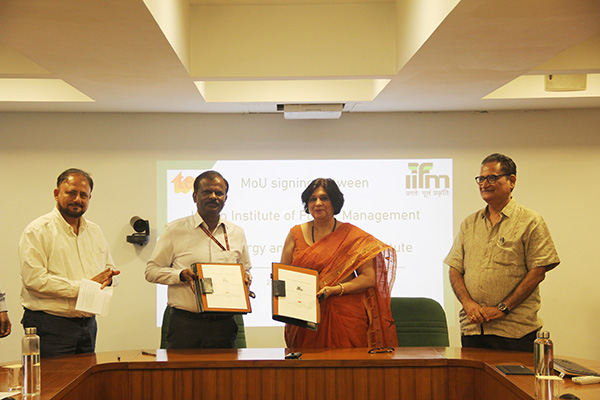
TERI and IIFM (Indian Institute for Forest management, Bhopal) have entered an MOU, which was signed by Dr Vibha Dhawan, Director General, TERI and Dr K Ravichandran, Director, IIFM. The event took place on 23 June 2025 at the TERI's office in India Habitat Centre, New Delhi.

TERI and the National Bank Staff College (NBSC) recently concluded a three-day training on Climate Financing: Opportunities & Risks for senior NABARD - National Bank for Agriculture and Rural Development officials between June 16 and 18, 2025. The objective of the training was to deepen the understanding, exchange insights, and strengthen strategic approaches to low-carbon climate-resilient development.

At the sidelines of the 7th Regional Committee Meeting of the International Solar Alliance, held in Colombo on July 16, 2025, a Memorandum of Understanding (MoU) was signed between Dr Vibha Dhawan, Director General, TERI, and H.E. Mr Tekeeua Tarati, Minister for Infrastructure and Sustainable Energy, Kiribati.
The MoU outlines collaboration on "Accelerating Resilient Infrastructure, Climate Solutions, Sustainable Energy, and Water Systems." This partnership marks a significant step in advancing cooperation between TERI and the Government of Kiribati to promote clean energy solutions and the development of sustainable infrastructure.

In a landmark development aimed at building a future-ready green workforce, The Energy and Resources Institute (TERI) and the Skill Council for Green Jobs (SCGJ) formalized a strategic partnership on Thursday with the signing of a Memorandum of Understanding (MoU) during India Energy Storage Week (IESW) 2025. The agreement aims to develop a collaborative framework for enhancing human resource capacity through joint initiatives focused on skill development, training, and knowledge exchange in the energy and environmental sectors.

TERI and Patanjali Research Foundation Trust (PRFT) signed a Memorandum of Understanding on August 6, 2025, to collaborate on a broad spectrum of scientific research and development initiatives.

The Energy and Resources Institute (TERI) and the National Solar Energy Federation of India (NSEFI) Green Data Center Coalition today signed a Statement of Intent (SoI) to jointly advance research, policy, and implementation strategies for greening India’s rapidly growing data center industry. The collaboration will focus on technical assistance, electricity demand analysis, and pilot demonstrations to accelerate the adoption of reliable renewable energy with storage solutions for data centers at an affordable cost.

TERI was honoured at the 1st BSG Awards for Excellence in Sustainability by Bharat Soka Gakkai (BSG) in New Delhi on September 3, 2025. The award acknowledges the TERI–BSG partnership in advancing environmental awareness, education, and sustainability. Dr Dipankar Saharia, Senior Director, TERI, accepted the memento on behalf of the organisation. The BSG Awards celebrate individuals and organisations contributing meaningfully to a sustainable future in alignment with the United Nations Sustainable Development Goals (SDGs).

Dr Vibha Dhawan, Director General, TERI, has been awarded the 'EmpowerHer: Leadership in Energy' award at the recent Bharat Electricity – Powering India Awards, held at New Delhi, on 2nd September, 2025. This distinguished award is a testament to Dr Dhawan’s remarkable leadership and profound contributions to the energy sector. Her visionary guidance continues to drive innovation and progress, shaping a more sustainable future for us all.

TERI and LDES Council have entered a Memorandum of Understanding (MoU) on July 21, 2025, to significantly advance Long Duration Energy Storage (LDES) technologies across India. The MoU's core purpose is to establish a partnership focused on promoting LDES deployment, developing crucial policies, and disseminating knowledge throughout the country.

TERI’s Sustainable Buildings Division signed a strategic MoU with Krisala Developers and VK:e Environmental LLP on May 22, 2025. This collaboration establishes TERI as the knowledge partner for the 105-acre Hiranandani Krisala Unicity Township in Darumbre, Pune—an ambitious and pioneering model for climate-responsive urban development. The partnership represents a first-of-its-kind initiative in Pune’s real estate sector, where sustainability, air quality management, and enhanced livability are integrated into every stage of township planning, development, and implementation.

TERI signed MoU with the Department of Environment, Government of NCT of Delhi, on May 22, 2025, to implement a large-scale sensitization campaign focused on promoting climate and biodiversity awareness among students through the school based Eco-Clubs. Targeting 2000 eco-clubs across Delhi, the campaign will be led by the Environment Education and Awareness Division of TERI to engage over two lakh students through a series of capacity building activities, thereby building a network of “eco-warriors.”

TERI was felicitated with a Certificate of Appreciation at the JEEV Awards 2025, held during the 4th BBB Summit & Expo on May 9, 2025, in New Delhi. Dr Sanjukta Subudhi, Associate Director, Advanced Biofuels and Biochemicals, TERI, accepted the award on behalf of the organization. The award recognizes TERI’s outstanding contributions in the category of 'Operational Excellence in Biomaterials', acknowledging its exceptional practices in sustainable biomaterial manufacturing.

Dr Vibha Dhawan, Director General, TERI, was honored with the Women On Top (WOT) Award 2025 for her exceptional contributions to research, innovation, and environmental leadership. Recognizing her remarkable impact in the field of sustainability, the WOT Awards jury lauded Dr Dhawan’s unwavering commitment to advancing environmental science and her dedication to transformative change.

TERI’s Southern Regional Centre (SRC), recognized for its contributions to developmental initiative monitoring, recently secured a four-year contract with Karnataka's Watershed Development Department (WDD) for MEL&D of the ‘Comprehensive Environment Plan for Mining Impact Zone’ (CEPMIZ). Signed on January 27, 2025, this prestigious project, overseen by a Supreme Court-appointed committee, focuses on mitigating mining-related environmental damage across 2.8 lakh hectares in Ballari, Chitradurga, Tumakuru, and Vijayanagar districts of Karnataka.

The International Conference on “Agri-Inputs for Sustainable Agriculture and Climate” (AISAC-2025) happened at TERI Gram, Gurugram, with an emphatic call to harness nanotechnology and bio-based agri-inputs for achieving climate-resilient and environmentally responsible farming systems. Hosted by The Energy and Resources Institute (TERI) under its Sustainable Agriculture Programme (SAP), the three-day global conference brings together scientists, policymakers, industry leaders, and regulators from India and abroad to deliberate on the future of agri-inputs, policy frameworks, and technology dissemination for sustainable agriculture.

Green budgeting is both a strategic approach and a structured process designed to advance long-term sustainability objectives. Launched in September 2025, Green budgeting Toolkit 2.0 supports managing authorities and the research community in initiating or strengthening green budgeting efforts. The updated Toolkit provides practical, ready-to-use instruments such as a pro-forma for departmental self-assessment, a Green Budget Statement structure, presentation, and primer and playbook.
TERI engages with multiple facets of sustainable development from science and technology to policy. The Earth Pod steers conversations on issues related to climate change, energy transitions, and environment friendly growth.
.png)
In this episode of 'The Earth Pod', Dr Vibha Dhawan, Director General, TERI, brings focus to the mounting environmental challenges in the Indian Himalayan Region (IHR). From rapidly melting glaciers and the loss of rich biodiversity to the growing impacts of unsustainable tourism and unmanaged plastic waste, the Himalayas are sending out unmistakable warning signals. Dr Dhawan underscores the global significance of the region and the growing ecological and economic imbalance in hill development.

Mr Sanjay Seth, Senior Director, TERI and Vice President & CEO, GRIHA Council, explores what it truly takes to build infrastructure that safeguards both people and the planet. Is green always expensive? Can sustainable housing be affordable for all?
Take 3, a short video, features in-house experts who answer three questions on current developments in the sector.

In this special edition of TAKE 3, Mr Arupendra Mullick, Director, TERI, breaks down the significance of this major global climate conference in this special edition of TAKE 3. He talks about its global relevance and, most importantly, sheds light on India's indispensable role in shaping the future of international climate policy.

Dr Manish Kumar Shrivastava, Associate Director, TERI, reflects on the significance of the International Day of Climate Action, emphasizing the urgent need to build climate resilience across nations and communities.
TERI’s community radio ‘Kumaon Vani’ engaged in diverse projects to accelerate sustainable outcomes in the region. Some key undertakings include:
This year TERI made short films that strove to preserve the environment and empower lives.


